

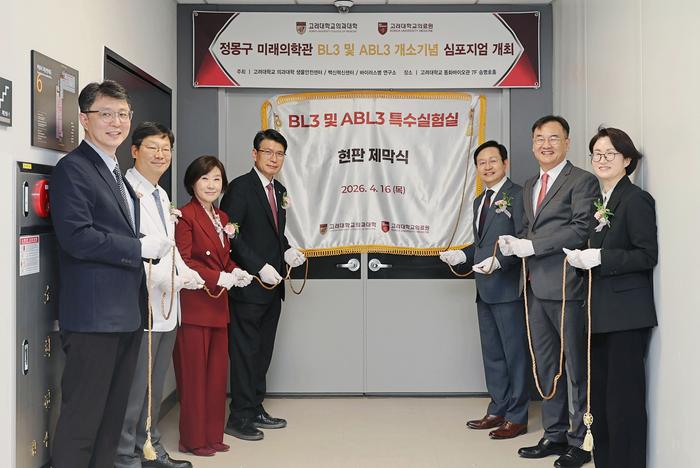
A major expansion of high-containment research infrastructure at one of South Korea’s leading academic medical institutions signals a significant step forward in the country’s pandemic preparedness posture. On April 16, Korea University Medicine officially inaugurated its newly relocated and expanded Biosafety Level 3 (BL3) and Animal Biosafety Level 3 (ABL3) laboratories, now the largest biosafety facilities of their kind among domestic universities in South Korea.
The ceremony, held at the Mediscience Park Chung Mong-Koo Future Medicine Building in Seoul, was followed by an opening commemorative symposium attended by more than 100 global experts in infectious disease and vaccine research. Senior officials from Korea University Medicine, the Korea Disease Control and Prevention Agency (KDCA), the International Vaccine Institute, the Finnish Institute for Health and Welfare, and several industry and academic bodies participated in the event.
Doubling Capacity for High-Risk Pathogen Research
The newly expanded facility is roughly double the footprint of its predecessor — and integrates research capabilities across the full spectrum of infectious disease science. This includes work on high-risk pathogens, vaccine and therapeutic development, infectious disease mechanism identification, and clinically linked research. The co-location of these functions under a single biosafety-certified roof is central to Korea University Medicine’s goal of operating what it describes as the first privately led “full-cycle vaccine development platform” in South Korea.
Director Park Man-seong of the Biosafety Center outlined an ambitious forward-looking vision for the facility, noting plans to evolve it into an “autonomous lab” leveraging artificial intelligence and automation technologies. The goal, he said, is to establish a next-generation research platform capable of supporting the development of vaccines and therapeutics within 100 to 200 days of a pandemic declaration — a timeline aligned with international targets set following the COVID-19 experience.
Korea University Medicine holds a distinctive position in the South Korean health research ecosystem. It is described as the only domestic tertiary general hospital with a research-focused hospital infrastructure, supported by affiliated Anam, Guro, and Ansan hospitals. That clinical depth, combined with expanded high-containment research capacity, positions the institution to bridge basic science and patient-centered outcomes in ways that few academic centers in the region can replicate.
International Voices Underscore the Stakes
The opening symposium drew substantive engagement from international stakeholders. Dr. Mika Salminen, Director General of the Finnish Institute for Health and Welfare, delivered a keynote address on next pandemic preparedness strategy, framing the challenge in terms that resonated across the assembled disciplines. “A pandemic is more than just about public health,” he said. “It is a complex crisis that requires a joint response from the nation and society as a whole.” He emphasized the need for early detection capabilities, expanded research infrastructure, stockpiled medical resources, international cooperation systems, and — critically — public trust in government as a determinant of collective response outcomes.
Director Nam Jae-hwan of the KDCA’s National Institute of Health echoed this sentiment, referencing lessons from the COVID-19 pandemic and signaling continued collaboration with Korea University in infectious disease surveillance, vaccine research, and response to emerging and mutated pathogens.
Boosting Domestic Capacity for Research and Response
The opening of South Korea’s largest university-based BL3 and ABL3 facilities reflects a broader trend among nations investing in domestic biosafety infrastructure as a strategic national security asset. The COVID-19 pandemic exposed critical vulnerabilities in global vaccine supply chains and pathogen research capacity, prompting governments and academic institutions worldwide to accelerate investments in biosafety-compliant research environments.
South Korea’s model — anchored in public-private-academic-research cooperation and oriented toward a rapid-response vaccine development timeline — offers a potential template for similar investments in other countries. For global health security professionals, the institutional framework being assembled at Korea University Medicine, including the integration of clinical research, basic science, and high-containment pathogen work within a coordinated governance structure, merits close attention as pandemic preparedness architectures are refined internationally.
Director Jung Hee-jin of the Vaccine Innovation Center noted that the expanded facility now enables the entire research process — from vaccine candidate discovery through efficacy verification — to be conducted on-site, a logistical and scientific advantage that could meaningfully accelerate timelines in future outbreak scenarios.
Sources and further reading:
Successful opening the largest BL3 and ABL3 special labs for the domestic universities and holding a symposium