

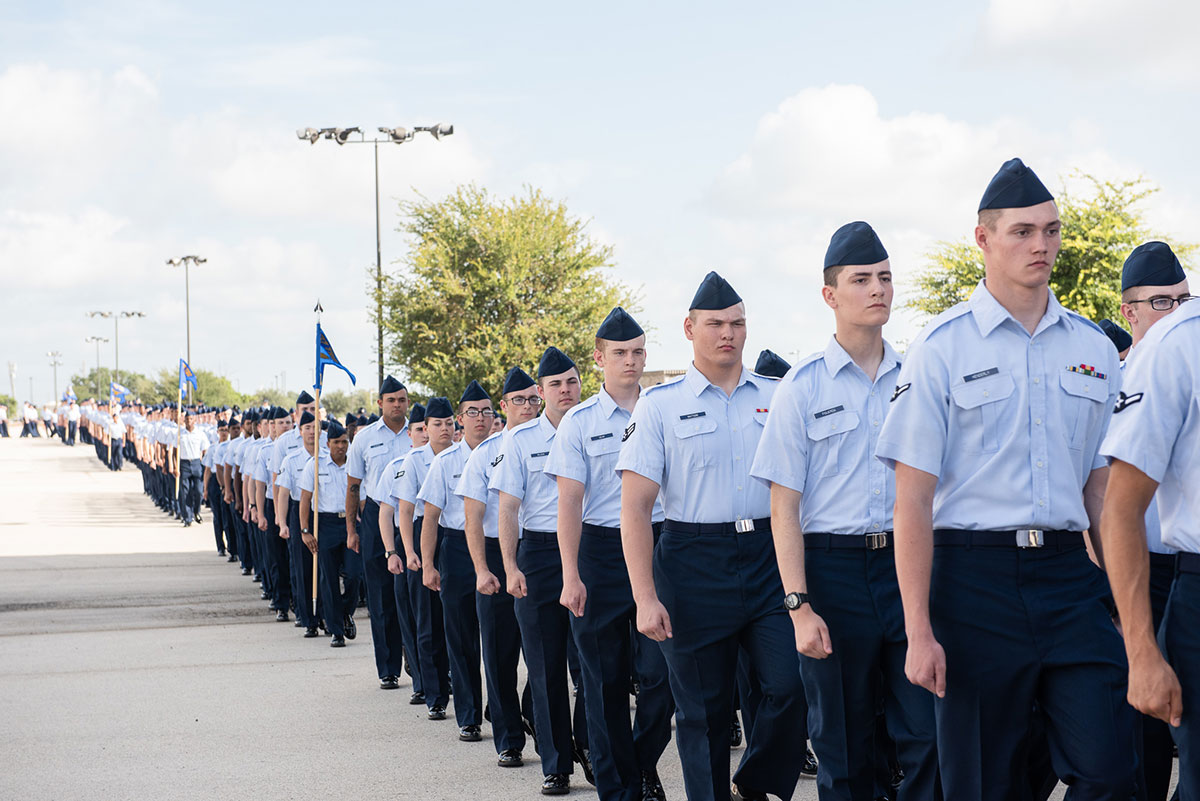
A flu outbreak that swept through Air Force basic training in the middle of summer — an unusual season for influenza — has forced the Department of Defense to reverse course on a vaccine policy change that was only two months old. The outbreak at Lackland Air Force Base in San Antonio, Texas, has sickened approximately 275 recruits, hospitalized at least four, and coincided with the death of a trainee, Keon McDaniel, who fell ill during his sixth week of basic training, though the Air Force has said it is still investigating whether his death was directly related to influenza.
The outbreak followed Defense Secretary Pete Hegseth’s April 21 announcement making the influenza vaccine optional for all U.S. military personnel — ending a mandate that had been in place, with one brief pause, since 1945. In the weeks after the policy took effect, only about 40 percent of Air Force trainees at Lackland opted to receive the vaccine, down from near-universal compliance under the prior mandatory policy.
Outbreak Was Foreseeable — and Foreseen
What makes the episode particularly notable from a public health standpoint is that military leaders anticipated the problem almost immediately. According to Pentagon officials, on May 5 — just two weeks after Hegseth’s order took effect — the Army, Navy, Marine Corps, and Air Force jointly asked the secretary of defense’s office for permission to reinstate flu vaccination requirements for recruits at basic training, deploying personnel, and military health care providers. The Army memo cited the particular vulnerability of trainees who sleep in open bays on bunk beds and share communal meals.
Permission was not granted until June 16 and 17, when Anthony J. Tata, under secretary for personnel and readiness, signed memos authorizing the exemptions. By that point, influenza was already spreading through the Air Force basic training wing at Lackland. A Pentagon spokesman later stated that the timing of the memos was not necessarily driven by the outbreak itself — a claim that epidemiologists and public health experts have received skeptically.
The Pentagon confirmed shortly afterward that all military service branches are once again requiring flu vaccinations for basic training recruits.
The Epidemiology Was Never in Doubt
The outbreak at Lackland illustrates the core logic of infectious disease transmission, which public health professionals describe using the basic reproduction number, or R₀ — the average number of secondary infections one infected person generates. When vaccination rates dropped from near 100 percent to roughly 40 percent, the proportion of susceptible recruits in the barracks rose sharply, pushing the effective R₀ well above the threshold of 1.0 needed to sustain an outbreak.
The conditions at a basic training facility — close quarters, high contact rates, shared sleeping and dining spaces — are precisely the kind of environment that amplifies respiratory pathogen transmission regardless of season. While flu transmission is generally lower in warm, humid summer months, it does not disappear entirely, and congregate settings like military barracks can override the seasonal dampening effect.
Writing in The Conversation, an epidemiologist who studies vaccine-preventable diseases noted that the military’s historical approach to vaccination was rooted not in ideology but in hard operational experience. George Washington mandated smallpox inoculation for the Continental Army in 1777 after an outbreak contributed to the collapse of the northern campaign. The flu vaccine mandate itself grew directly from the 1918 influenza pandemic, which killed approximately 45,000 American soldiers — nearly as many as died in combat during World War I. Clinical trials in military recruits showed the first influenza vaccine reduced illness incidence by 85 percent, and the mandate was formalized in 1945.
Force Readiness and the Cost of Politicized Public Health
Hegseth framed his April announcement in the language of “medical freedom” and religious autonomy — rhetoric that emerged prominently during the COVID-19 vaccine debate — rather than on any new clinical evidence about influenza or vaccine effectiveness. Senator Roger Wicker of Mississippi, chairman of the Armed Services Committee and an Air Force veteran, expressed dismay at the policy at the time, noting that flu vaccination had historically been understood as a readiness issue, not a personal rights question.
For public health and biosecurity professionals, the Lackland outbreak is a case study in how policy decisions that reduce population immunity in high-density, high-contact settings translate directly and predictably into outbreaks. The Centers for Disease Control and Prevention estimated that the influenza vaccine prevented roughly 180,000 hospitalizations and 12,000 deaths during the 2024-2025 flu season. In military contexts, the calculus includes not just individual illness but unit readiness, training continuity, and operational vulnerability. A training cohort sidelined by a preventable illness is a cohort that cannot deploy, cannot train, and represents a gap in national defense capacity.
The decision to restore mandatory vaccination for recruits acknowledges what epidemiologists and military health officials have understood for decades: in congregate military environments, vaccine policy is force protection policy.
Sources and further reading:
Did Pete Hegseth single-handedly raise the R₀ of flu? – Inside Medicine
The military traded its flu vaccine mandate for ‘medical freedom’ – an outbreak quickly followed – The Conversation
Scores Fall Ill at Air Force Base After Hegseth Makes Flu Vaccine Optional – New York Times
Military Leaders Sought Vaccination Program Weeks Before Flu Outbreak Hit Base – New York Times