

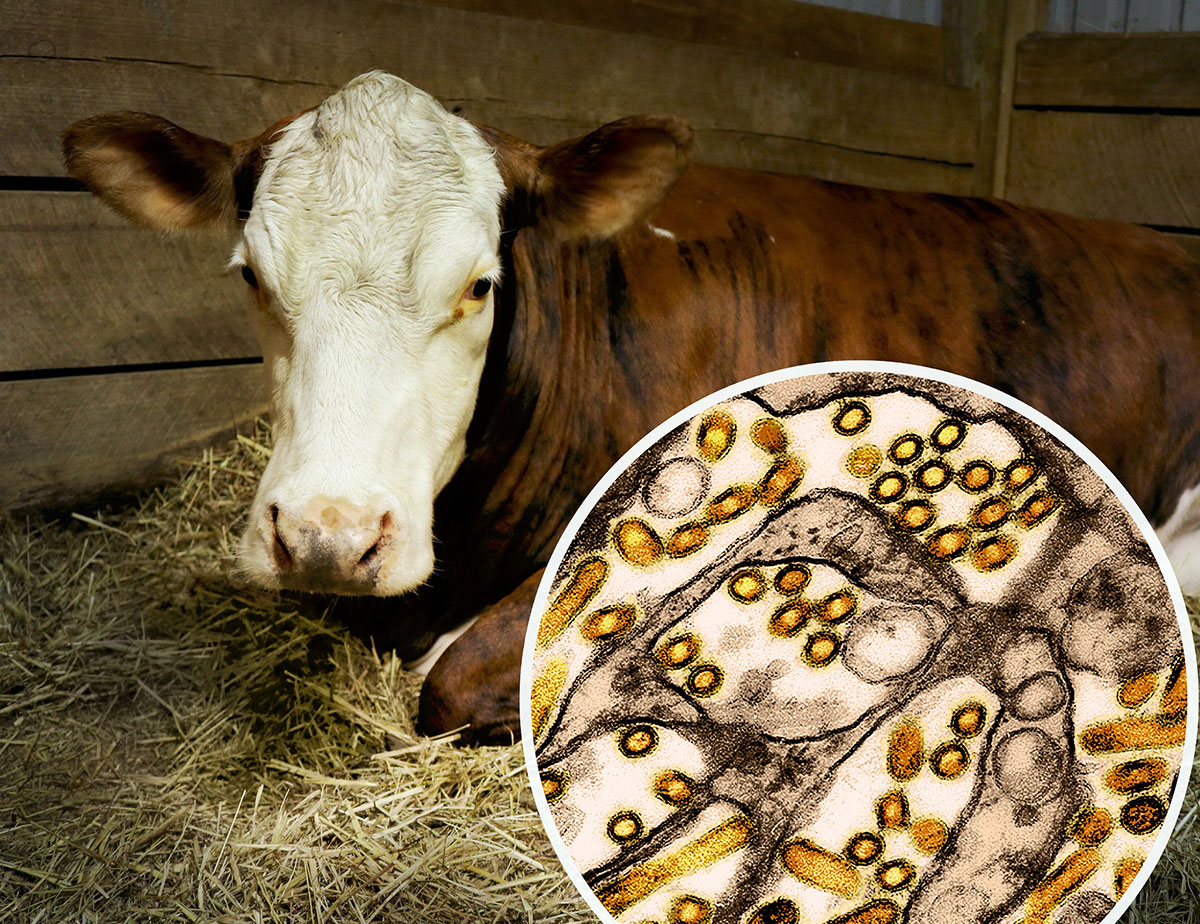
When influenza A(H5N1) was first detected in U.S. dairy cattle in March 2024, officials had identified fewer than 30 infected herds. The picture on grocery store shelves told a far more alarming story. A new surveillance study published in Emerging Infectious Diseases found that more than a third of pasteurized retail milk samples collected just weeks after that initial detection carried detectable H5N1 viral nucleic acid — a finding that revealed the outbreak was far more widespread than official case counts suggested and that passive surveillance had badly underestimated the virus’s footprint.
The study, conducted by a collaborative team from The Ohio State University College of Veterinary Medicine, St. Jude Children’s Research Hospital, and the University of Illinois College of Veterinary Medicine, examined retail milk as a proxy for the presence of H5N1 in dairy herds at two distinct timepoints during the outbreak. The results offer both a sobering look back at early surveillance failures and cautious evidence that federal intervention has since narrowed the virus’s reach.
One in Three Milk Samples Positive as Outbreak Went Largely Undetected
Between April 13 and May 3, 2024 — just days after only 29 herds had been officially confirmed — the research team purchased 168 pasteurized milk samples from retail stores across 13 states. Influenza A viral nucleic acid was detected in 36.3% of those samples. Perhaps more striking, positive samples were found in five states — Arkansas, Indiana, Minnesota, Missouri, and Oklahoma — where no dairy herd outbreaks had been officially reported at the time sampling began. The findings pointed to a surveillance gap of considerable magnitude: while fewer than 0.1% of U.S. dairy herds had been confirmed positive, viral RNA was turning up in more than one in three retail milk products.
The researchers screened samples for influenza A viral nucleic acid using real-time quantitative PCR, confirmed subtype via a separate laboratory at St. Jude Children’s Research Hospital, and conducted viability experiments to assess whether infectious virus was present. Critically, no viable virus was recovered from any of the IAV-positive pasteurized milk samples tested — consistent with existing evidence that pasteurization effectively inactivates the virus and that the commercial milk supply does not represent a direct infection risk to consumers through this route.
The authors note that retail milk is an imperfect surveillance tool: because commercial milk represents a composite drawn from many cows and processed in bulk, pinpointing the farm or county of origin is difficult, and the location of the processing plant may not reflect where the milk was originally collected. These limitations constrain the geographic precision of the findings and complicate efforts to trace viral evolution at a granular level.
Federal Orders Appear to Have Narrowed — But Not Eliminated — the Outbreak
By the second sampling period, conducted between December 27, 2024, and January 29, 2025, the picture had changed substantially. Of 477 milk samples collected across 25 states, only 6.9% tested positive for influenza A viral nucleic acid — a dramatic decline from the 36% detected eight months earlier. All positive samples in the second period were processed in California, a state that had reported 225 newly confirmed infected herds in December 2024 alone. The convergence between state-level herd reporting and retail milk positivity in the later period suggests that enhanced federal surveillance had meaningfully improved outbreak detection and, to some degree, geographic containment.
Two federal actions appear to have driven that shift. The U.S. Department of Agriculture’s April 24, 2024 order mandating pre-movement testing of lactating dairy cattle before interstate transport was followed in December 2024 by the launch of the National Milk Testing Strategy. The implementation of these programs coincided with a surge in officially confirmed infected herds — now exceeding 1,000 nationally — consistent with what would be expected when passive surveillance is replaced by systematic, active testing. The authors also acknowledge that natural immunity acquired through prior infection may be contributing to reduced transmission, though the duration and protective scope of such immunity remain uncharacterized.
Early Gaps Carry Real Biosecurity Consequences
The findings carry significant implications for biosecurity policy and pandemic preparedness. Phylogenetic analyses cited in the paper suggest that a single spillover event from wild birds to dairy cattle likely occurred in late 2023 and went undetected for several months — providing the virus ample opportunity to spread through cattle movements before any federal response was mounted. That lag between biological reality and official awareness represents precisely the kind of surveillance blind spot that biosecurity frameworks are designed to prevent.
For a dairy industry that comprises 9.3 million cows producing more than 226 billion pounds of milk annually, the scale of undetected circulation during the early outbreak phase underscores how quickly zoonotic pathogens can establish themselves within economically critical agricultural systems. The identification of two additional H5N1 spillover events — of the H5N1 D1.1 genotype — through the National Milk Testing Strategy further illustrates that transmission dynamics remain complex and incompletely understood. Despite the measurable progress reflected in the second sampling period, the authors are explicit: the virus has not been eliminated from U.S. dairy herds.
The study reinforces a familiar lesson: active, systematic surveillance consistently outperforms passive, symptom-driven reporting when the goal is early detection of novel zoonotic threats.
Sources and further reading:
Tarbuck N et al. Retail Milk Monitoring of Influenza A(H5N1) in Dairy Cattle, United States, 2024–2025. Emerging Infectious Diseases. January 20, 2026.