

An Ebola outbreak driven by a rare viral strain has crossed a grim milestone, with the Democratic Republic of the Congo confirming more than 1,000 cases as of June 22 — making it the second largest Ebola outbreak ever recorded. The outbreak, caused by Bundibugyo virus, has spread faster than any previous Ebola outbreak in history, prompting the CDC and the Department of Homeland Security to activate enhanced travel screening, entry restrictions, and flight rerouting protocols to protect the United States.
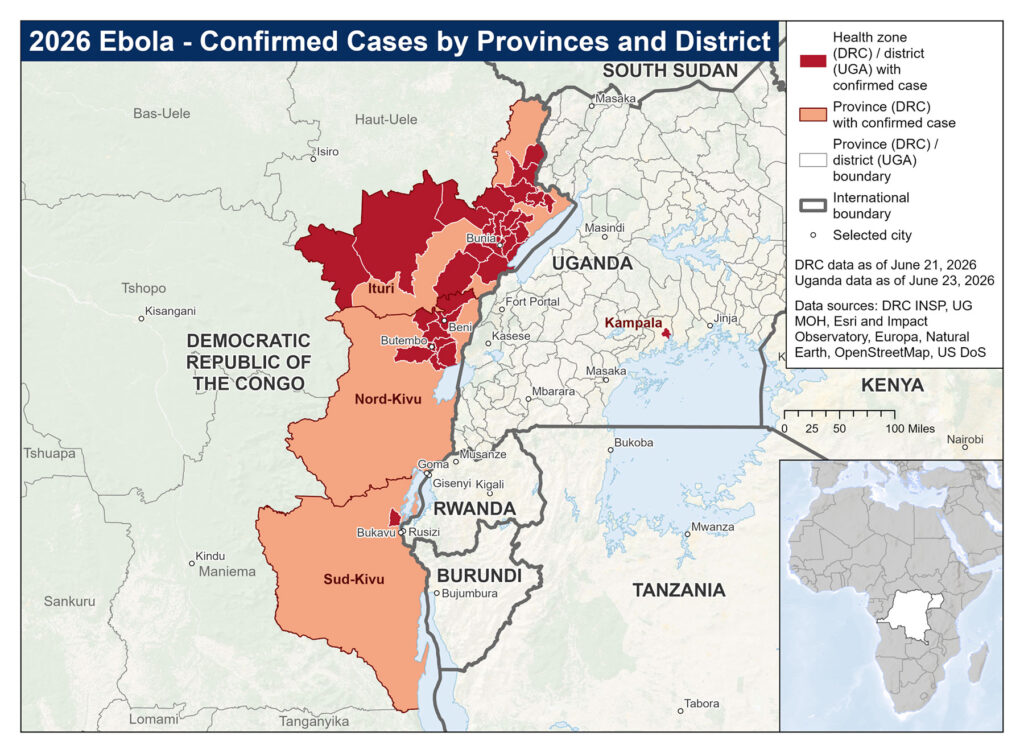
As of June 22–23, 2026, the DRC Ministry of Health reported 1,048 confirmed cases and 267 confirmed deaths. Uganda has reported 20 confirmed cases, 2 confirmed deaths, 1 probable case, and 1 probable death, including cases linked to the outbreak in Kampala, the country’s capital. Combined, the outbreak has produced 1,068 confirmed cases and 269 confirmed deaths across both countries. CDC has issued Travel Health Notices for both the DRC and Uganda, and recommends avoiding non-essential travel to the DRC’s Ituri, Nord-Kivu, and Sud-Kivu provinces, where the outbreak has been confirmed.
A Rare Virus Strain With No Vaccine and a History of High Fatality Rates
The outbreak began in early May when a hospital in Bunia Health Zone in northeastern DRC identified a cluster of severe illnesses among healthcare workers. Initial samples tested negative for Ebola virus, but follow-up testing found that 8 of 13 samples were positive for an orthoebolavirus. Genetic analysis confirmed the pathogen as Bundibugyo virus, one of four orthoebolaviruses known to cause Ebola disease in humans.
Bundibugyo is among the least common Ebola strains. There have been only two previous outbreaks: Uganda in 2007 and the DRC in 2012, with case fatality rates of 32% and 55%, respectively. No approved vaccine exists for Bundibugyo virus — a critical distinction from Sudan and Zaire strains, for which vaccines are available. Treatment is limited to supportive care. Patients have presented with classic Ebola symptoms including fever, headache, severe weakness, vomiting, abdominal pain, nosebleeds, and hemorrhagic symptoms such as vomiting blood. This outbreak is now the largest ever caused by Bundibugyo virus.
U.S. Response: Flight Rerouting, Screening, and Entry Restrictions
No cases associated with this outbreak have been confirmed in the United States. Even so, CDC and DHS have implemented a coordinated set of border and travel measures. Air passengers arriving from the DRC, Uganda, and South Sudan — the latter included due to its shared borders with affected countries despite reporting no cases — are being rerouted to one of four designated airports: Washington Dulles International (IAD), Atlanta Hartsfield-Jackson International (ATL), George Bush Intercontinental in Houston (IAH), or John F. Kennedy International in New York (JFK). Airlines are working directly with affected travelers to rebook flights.
Why This Outbreak Demands Global Attention
The scale and speed of this outbreak are what set it apart. The fact that case counts have risen faster than in any previous Ebola outbreak on record — including the catastrophic 2014–2016 West Africa outbreak that killed more than 11,000 people — signals the need for urgent, coordinated international response. CDC modeling of various scenarios underscores that strong, immediate public health support in the DRC and Uganda is essential to bring transmission under control.
The absence of a Bundibugyo vaccine means that containment relies heavily on traditional outbreak control measures: case identification, contact tracing, isolation, and community engagement. Healthcare workers have been among the earliest affected, a pattern consistent with prior outbreaks and a warning sign for health system capacity in already resource-constrained settings.
For public health professionals monitoring this situation, CDC has issued interim guidance on managing travelers from affected countries and updated clinical and infection control recommendations for U.S. healthcare providers treating suspected or confirmed viral hemorrhagic fever cases.
Sources and further reading:
Ebola Outbreak: Current Situation (23 Jun 2026) – U.S. Centers for Disease Control and Prevention