

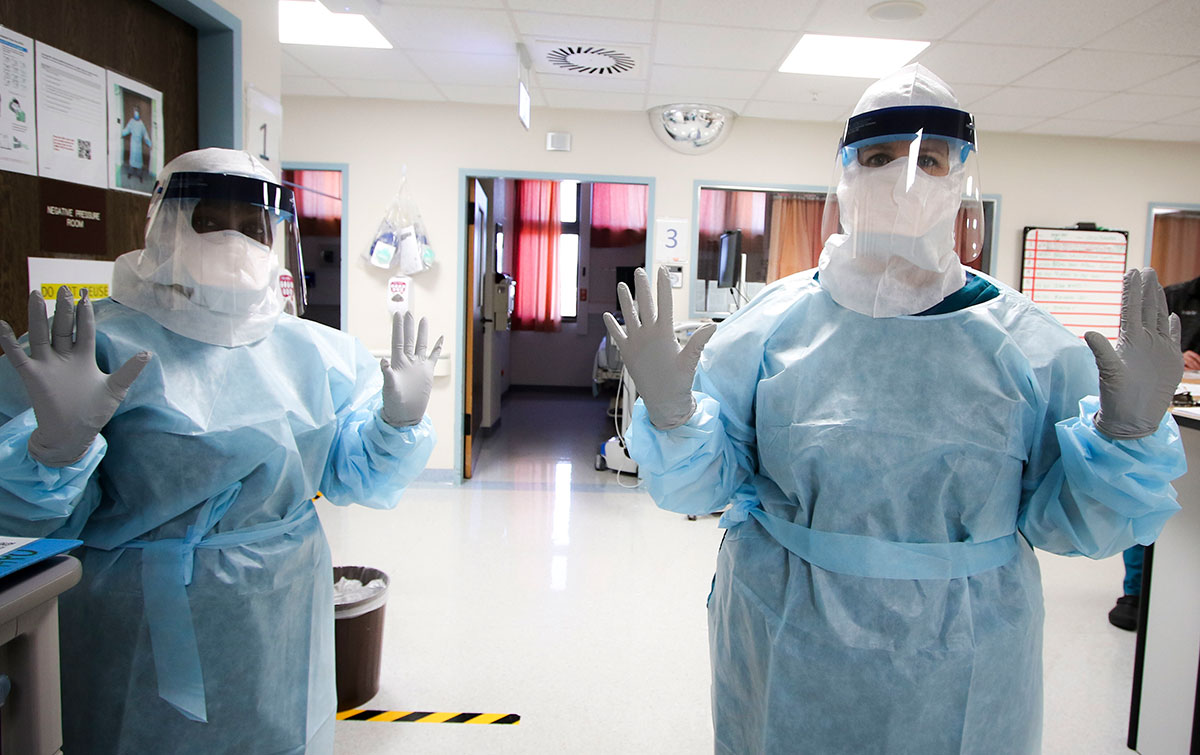
A new National Academies rapid expert consultation finds that while the core concepts behind crisis standards of care held up during COVID-19, putting them into practice was much harder than expected. The report identifies gaps in how health care systems recognize crisis conditions, coordinate across regions, and support workers during prolonged emergencies.
Crisis standards of care, first developed by the National Academies in 2009 and expanded in 2012, offer a systems approach for adapting health care delivery when demand outstrips available resources. During COVID-19, that framework was tested at scale for the first time. What happened often did not match the plan. Hospitals frequently adopted crisis level strategies without formally activating their plans. States rarely issued formal declarations. And bedside clinicians were often left to make difficult allocation decisions largely on their own.
These findings point to three separate steps in a crisis response: recognizing that a crisis exists, formally activating a plan, and actually implementing crisis strategies. During COVID-19, these steps did not always happen in order. The ethical foundations behind crisis standards of care held up well. The operational side needs work.
Why Systems Struggled to Recognize and Activate Crisis Protocols
Part of the problem is language. The term “crisis standards of care” became closely tied in many people’s minds to ventilator triage and worst case rationing, even though the concept was always meant to be broader. That narrower framing may have made public officials and hospital leaders reluctant to formally acknowledge crisis conditions, out of concern for public reaction or financial fallout.
Meanwhile, many of the shortages hospitals actually faced during the pandemic looked nothing like the scenarios that originally shaped this planning. Staffing gaps, medication shortages, and transfer delays created real risk to patients, but they did not fit neatly into a “catastrophic disaster” framework. That left many organizations unsure whether crisis standards even applied to what they were experiencing, or when to escalate.
Lack of coherent governance added another layer of difficulty. States rarely issued formal declarations, and even when they did, they typically left activation decisions to individual hospitals. That meant facilities often adapted care on their own, sometimes without clear legal protection or a clear chain of accountability. Shifting interpretations of civil rights law added to the uncertainty, making some hospitals hesitant to be transparent about the choices they were making.
When state support did not materialize as expected, the burden of managing scarcity fell to frontline clinicians. Many reported making high stakes decisions with little institutional backing or formal guidance. That experience contributed to lasting moral distress and burnout among health workers, effects that outlasted the pandemic itself.
Regional Coordination Offers a Path Forward
If there was one area that stood out as both a major gap and a major opportunity, it was regional coordination. States including Washington, Minnesota, and Arizona set up Medical Operations Coordination Centers to manage patient transfers, share capacity information, and balance patient loads across hospitals. These centers helped prevent local strain from tipping into full crisis conditions by identifying open beds elsewhere and moving patients before things got worse.
The impact was measurable. Evidence suggests that coordinated transfer management and load balancing may have prevented a significant share of excess deaths during pandemic surges. Yet many of these coordination centers were shut down once the immediate crisis passed, largely due to funding, staffing, and questions about who should oversee and sustain them long term. That is a missed opportunity, since the same infrastructure could help manage the next public health emergency, whatever form it takes.
And the next emergency may look quite different. A large scale domestic mass casualty event, such as a nuclear accident, could generate sustained waves of casualties across multiple regions, straining civilian trauma care, blood supplies, and rehabilitation services. High consequence infectious diseases pose a different kind of challenge entirely: the constraint may not be a specific treatment but the capacity to safely isolate, transport, and treat patients while protecting staff from exposure. And infrastructure failures, including cyberattacks, can cripple a hospital’s diagnostic and pharmacy systems without a single additional patient walking through the door, yet still create the kind of strain that demands a coordinated response.
The consultation points to several priorities for future work: clearer operational guidance, better decision support tools, stronger regional coordination frameworks, and more flexible approaches to workforce mobility. Much of this can and should happen before the next crisis hits. Investing now in coordination capacity and support for frontline workers may be the most effective way to keep hospitals functioning when the next emergency arrives.
Sources and further reading:
Updating Crisis Standards of Care: Examining Gaps and Opportunities: A Rapid Expert Consultation National Academies of Sciences, Engineering, and Medicine, Aug 2026
Hick JL, Hanfling D, Wynia MK. Hospital planning for contingency and crisis conditions: Crisis standards of care lessons from COVID-19. Joint Commission Journal on Quality and Patient Safety, June 2022.
This article was researched and sourced by Global Biodefense editors and reported with Claude AI assistance for drafting and editing.