

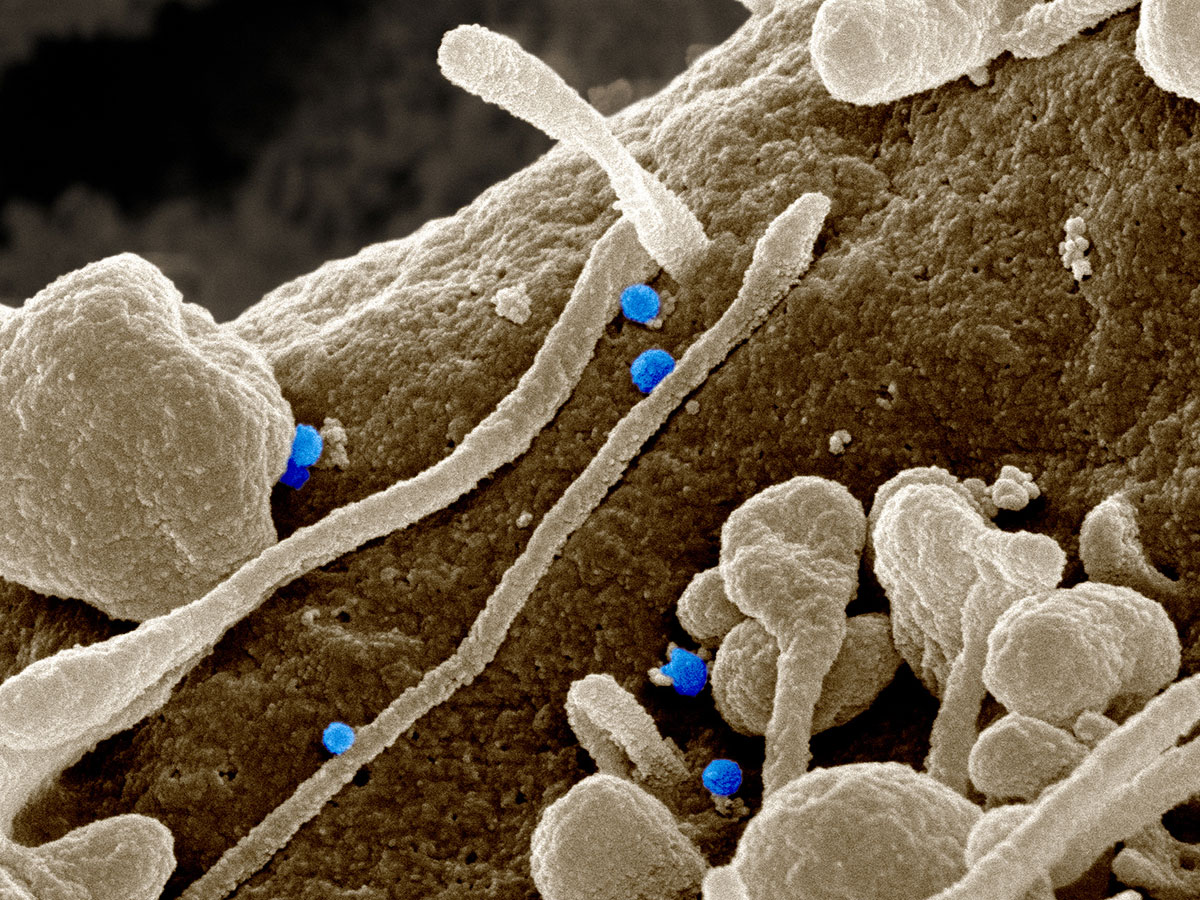
Crimean-Congo hemorrhagic fever virus has circulated for decades across a vast swath of Africa, the Middle East, and Asia, killing up to 40 percent of the people it infects, and it has no approved vaccine or treatment anywhere in the world. In recent years the tick species that carry the virus have also pushed into new parts of Europe, adding fresh territory to an already wide and long-standing threat. A new study published in Nature Communications by researchers from the U.S. Army Medical Research Institute of Infectious Diseases (USAMRIID), the CDC, the University of California Riverside, and collaborating institutions offers a detailed structural roadmap for how the immune system can still fight back against this virus, even without the kind of antibodies scientists have traditionally relied on to fend off other viral threats.
Most antiviral antibody research focuses on neutralizing antibodies, which physically block a virus from entering cells, typically by targeting proteins on the virus’s outer surface. For Crimean-Congo hemorrhagic fever virus, that strategy has largely fallen short. Instead, the research team focused on a different class of antibody, one that does not block infection directly but still protects the body from severe disease through mechanisms scientists are still working to fully understand. Their target was the virus’s nucleocapsid protein, an internal protein that packages the virus’s genetic material and happens to be both abundant and highly recognizable to the immune system.
The researchers tested nine different antibodies against this nucleocapsid protein, most originally developed years earlier at USAMRIID, alongside a previously identified antibody called 9D5 that had already shown promise. Using a technique that measures how antibodies compete with one another for binding space, they sorted the nine antibodies into four distinct groups based on where exactly each one attaches to the protein. They then tested each antibody’s ability to protect mice that lack a key antiviral immune pathway, a well established model for studying this virus, by injecting the antibodies before and shortly after exposing the mice to a lethal dose of the virus.
The results varied widely. Some antibodies provided no meaningful protection at all, while 9D5 stood out clearly, protecting 75 percent of treated mice from an infection that proved fatal to untreated animals. Notably, protection did not depend on which part of the protein an antibody targeted. The nucleocapsid protein has two structural sections, described as a head and a stalk, and the study found that antibodies binding to either nucleaocapsid region could confer meaningful protection, while other antibodies targeting the very same regions provided none. That finding suggests the precise location on the protein matters less than the exact angle and chemistry of how an individual antibody locks onto it, information that is difficult to predict without actually solving the physical structure of the interaction.
To understand what set the most effective antibody apart, the team turned to X-ray crystallography, a technique that reveals the three-dimensional shape of molecules down to the position of individual atoms. They captured detailed images of 9D5 clamped onto the nucleocapsid protein from an Afghan strain of the virus, along with additional structures of the unbound protein from two other strains. These images revealed that 9D5 grips a small, tightly packed pocket formed by several folded sections of the protein, a binding site that turned out to be remarkably consistent across the five major strain families of the virus found across Africa, Asia, and Europe, even though other parts of the protein vary considerably between strains. That consistency helps explain why 9D5 works broadly across such a genetically diverse virus, and offers researchers a specific structural target to aim for when designing future antibody therapies or vaccines meant to work regardless of which strain a patient encounters.
The findings carry direct relevance for medical countermeasures research and development. Crimean-Congo hemorrhagic fever virus is listed by the World Health Organization as a priority pathogen precisely because it combines high mortality with an expanding geographic footprint and a complete absence of licensed medical countermeasures. Because this newly detailed binding site remains structurally stable across strains from different continents, it gives drug developers a rational starting point for designing antibody treatments intended to work broadly, rather than needing to be re-engineered for each new outbreak. The researchers also note that combining antibodies targeting different, non-competing sites on the protein, such as pairing 9D5 with one of the stalk-targeting antibodies identified in this study, could offer a path toward even stronger protection than any single antibody alone.
The study’s authors caution that important questions remain unresolved, particularly around the precise biological mechanism through which non-neutralizing antibodies like 9D5 actually protect the body, since they do not work by simply blocking the virus. The team points to a cellular process involving an antibody-recycling protein called TRIM21, previously implicated in defense against other viruses, as a likely piece of the puzzle, and says further work is planned to pin down exactly how it applies to this virus.
Sources and further reading:
Moresco V, Garrison AR, Edmundo CA, et al. Structural and mechanistic insights into protective non-neutralizing antibodies targeting Crimean-Congo hemorrhagic fever virus nucleocapsid protein. Nature Communications, August 21, 2026.
This article was researched and sourced by Global Biodefense editors and reported with Claude AI assistance for drafting and editing.