


As mRNA vaccines and cancer immunotherapies move from a single pandemic-era success story toward a broader pipeline of applications, researchers are refining the delivery systems that carry mRNA into the body. One long-recognized optimization target is where the delivery particles actually end up: a significant share naturally accumulates in the liver rather than the immune tissues, such as the spleen, where vaccines need them most. Redirecting more of that dose to its intended target could make future mRNA-based therapies more effective and more efficient.
A new study from Japan’s Innovation Center of NanoMedicine (iCONM) and the Institute of Science Tokyo, published in ACS Nano, describes a method to do exactly that. The research team developed a coating agent that temporarily shields the liver’s entry points from incoming lipid nanoparticles, redirecting them toward the spleen instead.
How the coating works
Getting a lipid nanoparticle out of the liver means blocking its point of entry: the sinusoids, the network of small blood vessels that filter blood as it passes through the organ. The research team’s solution was a specially engineered molecule, a short chain of positively charged amino acids with two branches of polyethylene glycol (PEG) attached, a biocompatible polymer already used in various medical applications. Delivered ahead of the nanoparticles, this molecule settles onto the sinusoidal lining and lingers there briefly, on the order of hours, before the body flushes it out through the bile, temporarily blocking nanoparticle entry without causing lasting disruption to liver function. Because the coating agent has already passed through clinical trials as a delivery vehicle for a different class of therapeutics, its safety profile in humans is better established than that of an entirely new material.
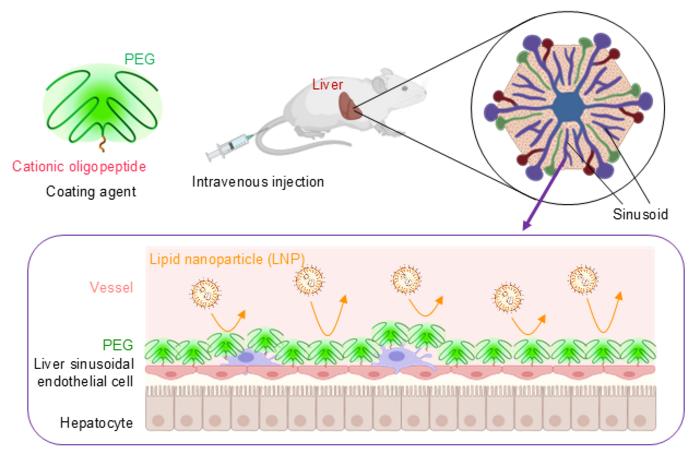
Using live imaging in mice, the researchers confirmed that lipid nanoparticles built up heavily along the liver’s sinusoidal walls when no coating agent was given, but that pretreatment largely prevented this accumulation. When the team then measured how much protein the delivered mRNA produced in different organs, they found that the coating cut liver protein expression by roughly 20 to 40-fold in some formulations, while boosting expression in the spleen several-fold. This pattern held whether the nanoparticles were injected into the bloodstream, into muscle tissue as a vaccine would be, or directly into a tumor.
Implications across three areas of active clinical development
The findings carry direct relevance for three infectious disease vaccines, cancer vaccines, and cytokine-based cancer immunotherapy. For a vaccine modeled on the spike protein used in COVID-19 shots, the coating agent suppressed liver protein expression without weakening the immune response and, notably, strengthened the induction of cellular immunity, the T-cell response considered central to fighting both infections and tumors. That distinction matters because unwanted antigen expression in the liver has been linked to rare cases of vaccine-associated autoimmune hepatitis in humans, while liver exposure can also dampen immune responses through the organ’s natural tolerance-inducing properties. For cytokine therapies delivered directly into tumors, where leakage into the bloodstream and subsequent liver accumulation can cause systemic inflammatory side effects, the coating reduced both liver and blood levels of the cytokine while preserving the treatment’s ability to shrink tumors.
For biomedical and health security stakeholders tracking the maturation of mRNA platforms beyond COVID-19, this line of research addresses a practical bottleneck: dose efficiency and off-target effects have been recurring themes as mRNA vaccines and immunotherapies move toward broader indications, including future pandemic pathogens. A delivery strategy that lowers effective dose while improving the safety profile could ease both regulatory review and manufacturing demands for next-generation vaccines.
The authors note that further work is needed before the approach reaches clinical use. Because the liver’s sinusoidal lining plays a role in clearing waste products, coagulation factors, and pathogens from the blood, longer-term studies are needed to confirm that temporarily blocking this function carries no unintended consequences, particularly with repeated dosing. The team also flagged that antibodies against PEG, now common in the population following widespread mRNA vaccination, could potentially interfere with the coating agent’s effectiveness and will need further evaluation.
Sources and further reading
Dirisala A, et al. 2-arm-PEG-oligocations transiently shield the liver sinusoids to mitigate off-target hepatic expression of mRNA lipid nanoparticles. ACS Nano. August 18, 2026.
Preventing the accumulation of mRNA-loaded lipid nanoparticles in the liver — Innovation Center of NanoMedicine
This article was researched and sourced by Global Biodefense editors and reported with Claude AI assistance for drafting and editing.