

As New World screwworm (NWS) detections in Mexico climb toward 2,000 confirmed cases and active infestations continue to be identified in states bordering the United States, the United States government is deploying emergency drug authorizations and breaking ground on a $750 million domestic fly production facility.
As of late April 2026, NWS has not been detected inside the United States. However, the U.S. Department of Agriculture (USDA) and partner agencies are treating the situation as a near-term threat requiring immediate preparation. All southern ports of entry remain closed to livestock trade, and USDA’s Animal and Plant Health Inspection Service (APHIS) is currently releasing 100 million sterile flies per week in Mexico to suppress the pest’s northward advance.
What Is New World Screwworm?
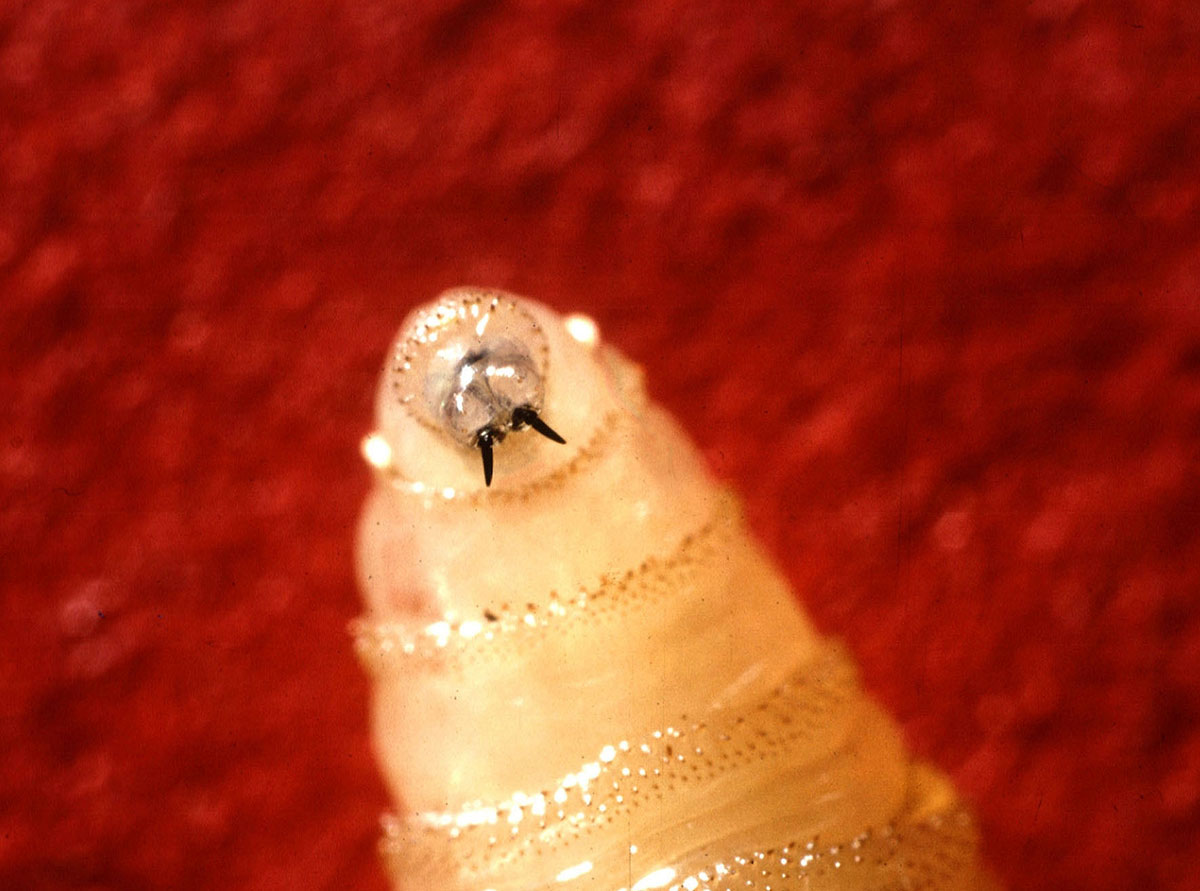
New World screwworm (Cochliomyia hominivorax) is a devastating parasitic fly whose larvae feed on the living tissue of warm-blooded animals, including livestock, wildlife, and in rare cases, humans. Female flies lay eggs in open wounds or natural body openings; the resulting larvae burrow into tissue, causing severe injury or death if untreated. The United States eradicated NWS domestically in the 1960s using the sterile insect technique (SIT), in which mass-reared male flies are sterilized by irradiation and released into affected areas. Because female screwworm flies mate only once, mating with a sterile male results in eggs that do not hatch, driving population collapse over time.
The pest was eradicated from Mexico and Central America through a decades-long binational program. A resurgence beginning in Panama and moving northward has now brought active cases deep into Mexico, with detections confirmed in states including Tamaulipas, Nuevo León, and Guanajuato — the latter representing a detection more than 100 miles outside the primary sterile insect dispersal zone.
Groundbreaking for Domestic Sterile Fly Facility
On April 17, 2026, U.S. Secretary of Agriculture Brooke Rollins and U.S. Army Corps of Engineers (USACE) commanding general Lieutenant General William “Butch” Graham led a groundbreaking ceremony at Moore Air Base in Edinburg, Texas, for a new state-of-the-art sterile fly production facility. USACE is overseeing engineering, design, construction management, and contract oversight for the project.
The facility represents a cornerstone of the USDA’s five-pronged strategy to combat NWS and is designed to reduce U.S. dependence on foreign production infrastructure. Key milestones include:
- Initial operational capability targeted for November 2027, reaching 100 million sterile flies per week
- Full production capacity of 300 million sterile flies per week following continued construction beyond initial operations
The new Texas facility will complement USDA’s ongoing operations at the Panama-based COPEG facility and a $21 million investment in modernizing Mexico’s Metapa facility, which is expected to become operational in summer 2026.
“Breaking ground on this facility marks a major investment in safeguarding America’s livestock and the producers who feed this nation,” said Secretary Rollins. “This puts NWS sterile fly production in American hands, so we do not have to rely on other countries for the best offensive measure to push screwworm away from our borders.”
Emergency Drug and Pesticide Authorizations
In a rapid-response regulatory push, multiple federal agencies have issued emergency authorizations for products to prevent and treat NWS infestations in animals.
FDA Emergency Use Authorizations (EUAs):
April 24, 2026: FDA authorized F10 Antiseptic Barrier Ointment with Insecticide (benzalkonium chloride, polyhexanide, and cypermethrin) for prevention and treatment of NWS myiasis in cattle, horses, minor hoof stock species, birds, and captive wild and exotic mammals. The product is available over the counter. Food safety withdrawal periods apply: treated cattle, goats, and sheep must not be slaughtered within 30 days; milk from treated animals must be discarded for 10 days post-treatment. The product is not authorized for use in domestic dogs or cats.
April 27, 2026: FDA authorized Negasunt Powder (coumaphos, propoxur, and sulfanilamide) for prevention and treatment of NWS in cattle, swine, goats, sheep, horses, donkeys, mules, and captive wild and exotic mammals. Distribution is currently limited to USDA for authorized federal, state, local, and tribal agency use only. A 28-day pre-slaughter withdrawal period applies. Two active ingredients — coumaphos and propoxur — carry neurotoxicity risks requiring strict handling precautions.
EPA Emergency Exemption:
- On April 27, 2026, the U.S. Environmental Protection Agency granted USDA’s Emergency Exemption request under Section 18 of the Federal Insecticide, Fungicide, and Rodenticide Act (FIFRA) for Tanidil, a topical powder manufactured in Brazil that is similar in composition to Negasunt but lacks the added antibiotic. Because Tanidil is not currently available in the United States, APHIS must import and relabel the product — a process expected to take 90 to 100 days from the time the official order is placed. Distribution will be managed exclusively through USDA’s National Veterinary Stockpile in coordination with state animal health officials. Some states may require additional state-level registration before the product can be used.
Updated National Response Playbook
On April 8, 2026, APHIS released an updated NWS Response Playbook, a comprehensive operational guide for federal, state, tribal, and local responders in the event NWS is detected inside the United States. The playbook was developed through extensive stakeholder engagement, including state animal health officials, livestock and wildlife industry groups, tribal partners, and veterinary organizations.
Key updates include clarification of terminology, expanded guidance on animal movement restrictions, refined roles and responsibilities for wildlife management, and the addition of eight new supplemental guidance documents. The playbook addresses how responders would coordinate operations, reduce spread, manage infested animals, implement surveillance and sterile insect controls, and maintain continuity of business operations during an active response.
Severe Consequences for Agro-Economy
An NWS incursion into the United States could be devestating for animal agriculture, wildlife populations, and rural economies. The United States is the world’s largest beef producer, and cattle-dense states like Texas — which borders the most heavily affected Mexican states — would be among the most vulnerable. Beyond livestock, NWS poses risks to deer and other wild ungulates, making containment a wildlife management concern as well.
The coordinated federal response — spanning USDA, FDA, EPA, and USACE — signals an elevated threat assessment and a deliberate effort to pre-position countermeasures before any domestic detection occurs. The expansion of domestic sterile fly production capacity addresses a longstanding vulnerability: current U.S. response capability depends heavily on facilities located in Panama and Mexico, countries that are themselves managing active outbreaks.
With nearly 2,038 case detections logged in Mexico as of late April 2026, and active cases confirmed in border states including Tamaulipas and Nuevo León, the window for purely preventive action may be narrowing. Federal officials have emphasized that the pace of recent regulatory authorizations, infrastructure investment, and planning updates reflects both the urgency of the situation and confidence in the science-based tools available.
Sources and further reading:
Latest Update on U.S. Response to New World Screwworm
USDA and U.S. Army Corps of Engineers Break Ground on New Texas Sterile Fly Production Facility
USDA Highlights EPA Emergency Exemption of Product To Treat New World Screwworm