

When a chemical-weapons attack strikes a civilian target, emergency physicians and hospital-based personnel face a problem that conventional mass casualty triage systems were never designed to solve: identifying what killed or incapacitated the patients arriving at their doors — and doing so fast enough to save them. A review article published in the New England Journal of Medicine by Gregory R. Ciottone, M.D., of Beth Israel Deaconess Medical Center and Harvard Medical School, provides emergency medicine practitioners with a structured, toxidrome-based framework for rapidly classifying chemical-warfare agents and initiating appropriate treatment during the acute phase of an attack.
Published in April 2018, the article remains a foundational clinical reference as chemical agents formerly associated with battlefield use have increasingly appeared in civilian and terrorist contexts — from sarin attacks in Syria to the use of VX in the assassination of Kim Jong-nam in Malaysia and the Novichok poisoning of Sergei Skripal in the United Kingdom.
The Core Clinical Problem: Identification Under Chaos
Chemical-weapons attacks arrive without warning and produce chaotic scenes that closely resemble conventional mass casualty incidents, particularly when chemical agents are combined with firearms or explosives in multimodal attacks. The review notes that most emergency medical responders and hospital personnel are underprepared and have limited training in recognizing chemical attacks or in correctly donning and doffing personal protective equipment. Without rapid identification of the agent class, clinicians cannot administer appropriate antidotes, and responders cannot select the correct protective equipment — both of which have direct life-or-death consequences.
Handheld field detection devices exist but vary in sensitivity and specificity and may require several hours for definitive classification. During initial patient encounters, clinical suspicion and toxidrome recognition — pattern-matched constellations of signs and symptoms characteristic of a given agent class — are the primary tools available.
A Tiered Triage Framework Organized by Lethality
The article presents a two-step rapid triage algorithm organized around a core clinical principle: identify the most rapidly lethal agent classes first, because those patients require emergency antidote administration before or concurrent with decontamination. The framework covers eleven classes of chemical-warfare agents, including nerve agents, asphyxiants, opioids, anesthetic agents, anticholinergic agents, vesicants, caustic agents, riot-control agents, pulmonary agents, T-2 toxin, and botulinum toxin.
The first tier of the triage algorithm prioritizes three agent classes requiring immediate antidote administration. Nerve agents — identified by fasciculations, muscle weakness or paralysis, increased secretions, and miosis — require immediate atropine and pralidoxime. Asphyxiants such as cyanide — presenting with respiratory distress, gasping, collapse, and seizures — require hydroxocobalamin or sodium thiosulfate and sodium nitrite. Opioid agents — presenting with bradypnea, sedation, and miosis — require naloxone. All three classes also require urgent spot decontamination.
The second tier addresses agent classes for which no specific antidote exists, requiring decontamination, supportive care, and close monitoring: anesthetic agents, pulmonary agents, vesicants, caustic and riot-control agents, T-2 toxin, anticholinergic agents, and botulinum toxin. The article notes that peripherally acting pulmonary agents — such as phosgene — may present with few or no initial symptoms except at high doses, with delayed-onset shortness of breath and chest tightness developing later, a pattern that can mislead initial triage if clinicians are not specifically watching for it.
Decontamination as a Medical Countermeasure
The review is explicit that decontamination is not a separate function from treatment — it is itself a medical countermeasure that limits the conversion of external exposure to internal dose. For rapidly toxic agents, immediate spot decontamination at the scene may be lifesaving before full decontamination is possible. The article also addresses secondary exposure risk: most chemical-warfare agents pose significant hazards to responding personnel through direct contact or off-gassing from contaminated patients, a risk documented following the 1995 Tokyo subway sarin attack when medical staff in the emergency room experienced secondary sarin exposure.
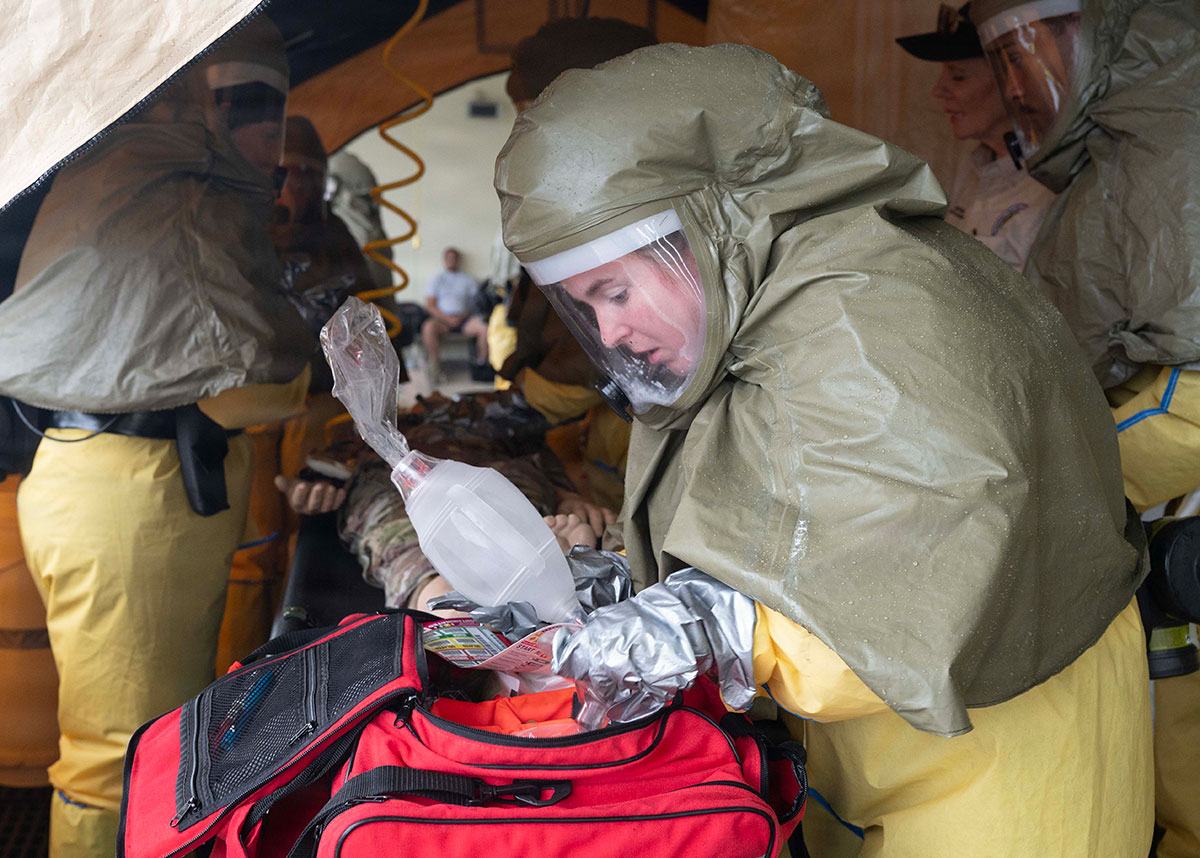
Scene safety decisions — including establishing hot, warm, and cold zones; assessing whether a release is isolated or dispersed; and determining vapor state and wind patterns — must precede or occur simultaneously with patient care, with the OSHA recommendation for unknown agents being Level A protective equipment.
Accompanying Clinical Video Resource
The New England Journal of Medicine has published an accompanying animated video, Toxidrome Recognition and Response, which walks clinicians through the recognition of and medical response to a simulated chemical-weapons attack, covering multiple agent classes, clinical presentations, antidote administration, and the practical application of toxidrome-based triage. It serves as a useful visual companion to the Ciottone framework for clinical training and hospital preparedness exercises.
Ciottone GR. Toxidrome Recognition in Chemical-Weapons Attacks. N Engl J Med. April 26, 2018