

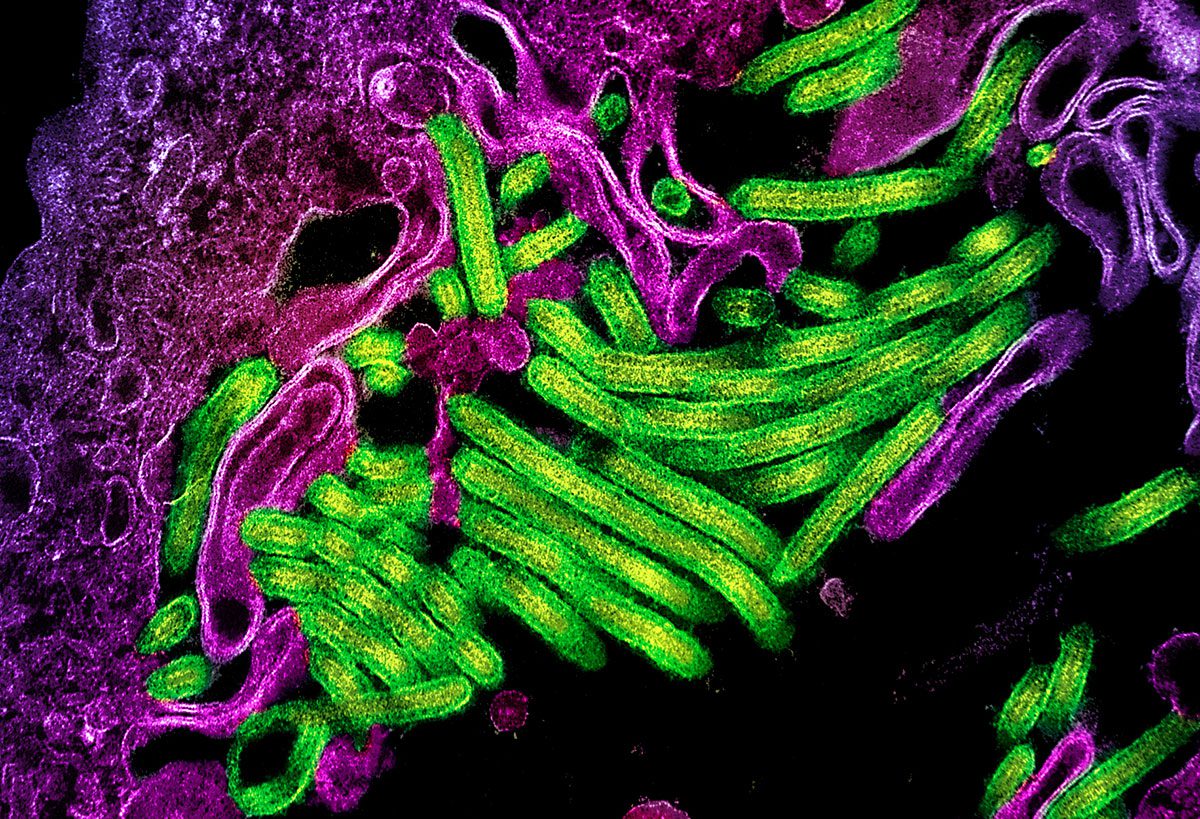
A new scientific review examines a well established but still poorly characterized feature of Ebola virus disease: in some survivors, the virus persists for months or years in parts of the body the immune system treats with a lighter touch, occasionally resurfacing to cause new infections or seed fresh outbreaks entirely on its own. The review then asks a more pointed question that has received comparatively little direct study: whether HIV-associated immune dysfunction shapes how long that persistence lasts.
Researchers from the University of Catanzaro and the Renato Dulbecco Teaching Hospital in Italy published the analysis in the journal Viruses as part of a special issue examining lessons from the ongoing Bundibugyo virus outbreak in the Democratic Republic of Congo. Much of the underlying evidence of the narrative review traces back to the 2013 to 2016 West African outbreak, an event so large that it left behind more survivors to study than any prior Ebola epidemic, which is when viral persistence first became a recognized clinical concern.
Ebola virus RNA has been documented months or years after apparent recovery in what scientists call immune-privileged sites, a handful of body compartments where the immune system naturally dials back inflammation to protect sensitive tissue and organ function. Researchers have found evidence of lingering virus in the testes, the eyes, and the central nervous system, and, in a more recently identified case, in breast milk. That same biological restraint that shields these tissues from damage can also let small amounts of virus go undetected long after it clears from the bloodstream. The male reproductive tract remains the best studied of these reservoirs, with documented cases of virus persisting in semen for extended periods after recovery, prompting national testing and counseling programs in West Africa aimed at reducing the risk of sexual transmission.
That risk is well documented. Genetic analysis has directly linked new infections to virus recovered from long-recovered survivors, confirming that persistent reservoirs can transmit disease under the right circumstances. Perhaps the clearest example came from Guinea in 2021, when investigators traced a new outbreak not to a fresh spillover from an animal host, the traditional explanation for how Ebola outbreaks begin, but to virus that had persisted in a single survivor for years. That finding reshaped how public health officials think about outbreak surveillance, since it means an epidemic can theoretically reignite long after active transmission has stopped and case counts have gone to zero.
What remains far less clear is why persistence varies so much from one survivor to the next. The authors point to growing evidence that many survivors experience lasting immune dysfunction long after clearing the virus from their blood, including chronic inflammation and altered immune cell activity that can persist for years. People living with HIV often show lingering immune activation, exhausted T-cells, and a weakened ability to fight off viruses, even when their HIV is well controlled with antiretroviral therapy. Parts of Africa hit hardest by past Ebola outbreaks also carry some of the world’s highest HIV burdens, yet almost no research has directly studied patients who have faced both infections.
The authors are careful to frame the HIV connection as a hypothesis grounded in biological plausibility rather than an established finding. They cite only a single published case report describing prolonged viral persistence in an Ebola survivor who also had HIV, far too limited a dataset to draw firm conclusions. Much of the supporting evidence instead comes indirectly, from studies of how immune-compromised patients respond to other persistent viral infections, and from laboratory research on cellular pathways, such as one involving a cholesterol transport protein called NPC1, that may influence how efficiently the body clears residual viral material from tissue.
If host immune status genuinely shapes how long a survivor can carry replication-competent virus, that has direct consequences for surveillance strategy, semen testing programs, and how long survivor monitoring should realistically continue after an outbreak is declared over. The authors also flag an immediate research opportunity in the current Bundibugyo virus outbreak, noting that most of what is known about Ebola persistence comes from studies of the more extensively researched Zaire ebolavirus species, leaving open the question of whether Bundibugyo virus behaves the same way in survivors.
The authors explicitly state that no study has yet established HIV as a factor that worsens or prolongs Ebola virus persistence, and they urge future research to enroll HIV-positive Ebola survivors in structured, long-term cohorts that track viral and immune markers together, rather than continuing to rely on scattered case reports. As the population of Ebola survivors worldwide continues to grow, the authors argue that closing this evidence gap deserves treatment as a genuine research priority, not a secondary academic question.
Sources and further reading:
De Maria F, Fusco P, Russo A. Ebola Virus Persistence Beyond Acute Infection: Could HIV-Associated Immune Dysfunction Influence Survivor Biology? Viruses, July 9, 2026.
This article was researched and sourced by Global Biodefense editors and reported with Claude AI assistance for drafting and editing.