

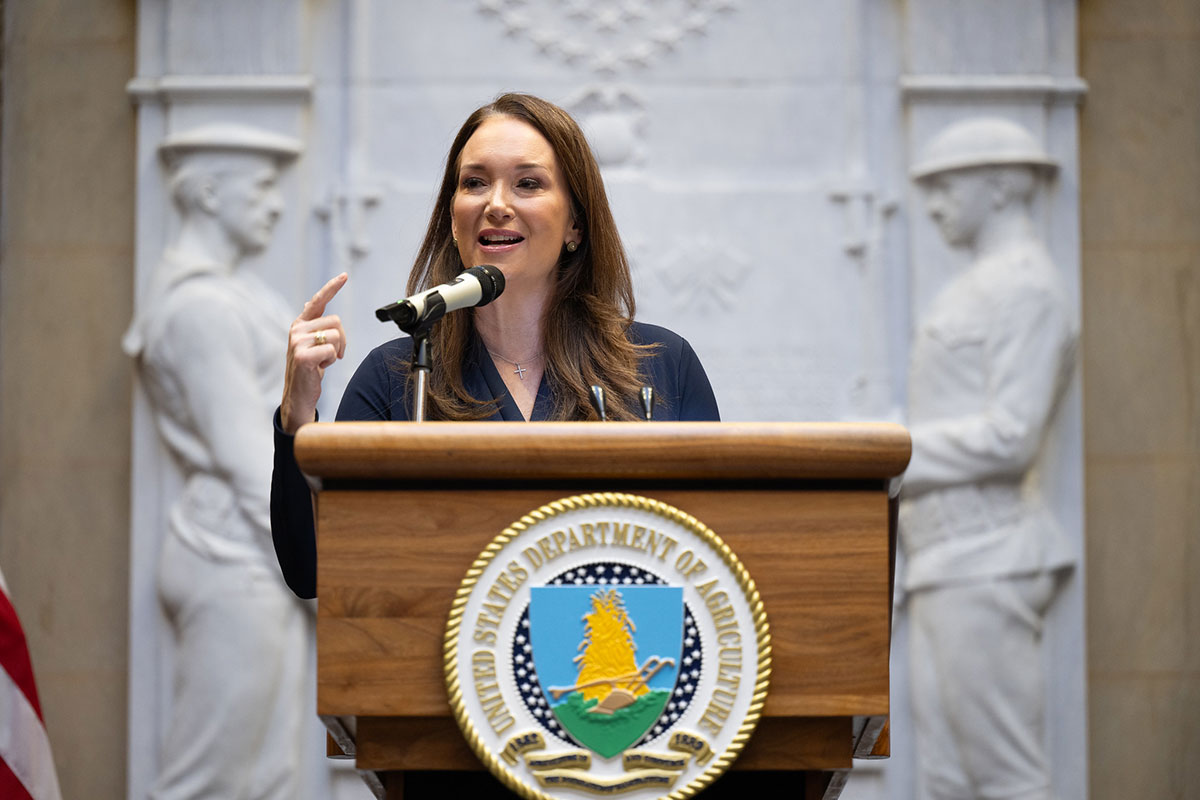
Few federal departments carry as much quiet responsibility for the nation’s health security as the Department of Agriculture. Its inspectors catch pests and pathogens at the border, its laboratories and veterinarians watch for foreign animal disease, and the milk testing that serves as an early warning for H5N1 in dairy cattle runs through its programs. When a department like that announces a sweeping reorganization, forced relocations and a shrinking workforce all at once, the public is owed an account of why these changes make sense. A Government Accountability Office report released Nov. 9, 2026 finds that, as far as anyone outside the department can tell, no such account exists.
What GAO Found
GAO prepared the report for the ranking members of the Senate and House agriculture committees. It examines Secretary of Agriculture Brooke Rollins’ July 24, 2025 reorganization memorandum, which set out four pillars: aligning workforce size with financial resources, moving resources outside the National Capital Region, eliminating management layers and consolidating support functions. The memo called for relocating at least 2,600 of 4,600 headquarters and National Capital Region staff to five hub locations and other cities.
Beginning in Sep. 2025, GAO repeatedly asked USDA for documentation of any analysis behind those decisions. USDA provided raw daily attendance counts for four buildings and a 2024 report on Forest Service finances. GAO concluded that none of it was analysis informing the specific decisions. The result, GAO says, is that Congress and the public do not know whether USDA examined how the reorganization would affect service delivery, what it would cost the economy, or how to protect taxpayers when disposing of property.
A Fifth of the Workforce Gone
Federal workforce data show USDA’s headcount fell from about 91,000 in December 2024 to fewer than 73,000 in March 2026. The department had about 25,400 separations and about 7,200 hires over that period. About half the separations (52%) came through the Deferred Resignation Program, and fewer than 10 were reductions in force. GAO notes that USDA pursued staff reductions separately from the reorganization, in response to presidential directives, so the decline cannot be attributed to the reorganization alone.
Declines ranged from 12% at the Forest Service to 41% at the National Institute of Food and Agriculture. Several agencies with biosecurity and food safety roles saw significant reductions:
- Animal and Plant Health Inspection Service (APHIS): 8,637 to 6,672 employees, down 22.8%
- Agricultural Research Service: 7,127 to 4,846, down 32.0%
- Food Safety and Inspection Service: 8,383 to 7,368, down 12.1%
Voluntary departures do not choose which skills the department keeps. Employees do. GAO’s leading practices call for determining critical skills and competencies before downsizing, which is precisely the planning GAO could not find. A contraction of this size, paired with a forced relocation of this scale, has few modern parallels.
Lessons from Past Relocation Efforts
GAO says earlier relocations offer a cautionary precedent. When USDA moved the Economic Research Service and the National Institute of Food and Agriculture to Kansas City in 2019, more than half of each agency’s staff left. The share of employees with two or more years of experience fell from 84% to 34% at the research service and from 82% to 21% at the institute. Fewer research reports were produced, and grant processing times lengthened. Two years later, staffing and productivity had generally recovered, though changes in staff composition were more lasting. At the Bureau of Land Management, 135 of the 176 staff who needed to relocate separated from their positions after its 2019-2020 headquarters move.
USDA Issues Combative Response to GAO Report
In written comments, USDA called GAO’s review partisan, politicized and incomplete, according to GAO, and described the Secretary’s memorandum as a framework of key principles that could be adjusted. The department pointed to what it called basic realities, including Forest Service financial difficulties, workforce growth under the prior administration and its real estate footprint in the National Capital Region. GAO responded that these conditions do not show that analysis informed the specific decisions, and that it stands by its findings.
The Stakes for Biosecurity
GAO did not examine how the reorganization or the staffing declines affect animal disease response, food safety inspection or agricultural research, and its report draws no conclusions about them. But the people who work in these systems were already asking for more capacity.
In March, a coalition of 20 scientific societies and agricultural groups urged Congress to fund APHIS at $400 million for animal health and $390 million for plant health in fiscal 2027, and warned that the National Bio and Agro-Defense Facility in Kansas, built in 2022, was neither fully operational nor fully staffed.
In Kansas, two lawmakers from different parties introduced a bill to stop USDA from closing field offices and to set minimum staffing levels, after the state lost more than 500 USDA employees, about 32%. Rep. Derek Schmidt said many rural offices have only one or two people, so a single departure can leave one unable to function. Secretary Brooke Rollins has acknowledged the firings were an “imperfect process.”
What Congress Should Ask For
A federal judge stopped much of the reorganization on October 13, finding that the unions suing USDA were likely to show it violates a provision in this year’s appropriations law barring reorganization without congressional approval, according to Federal News Network. USDA is appealing to the Ninth Circuit. The court noted that the stay may be short-lived, because the provision sits in a continuing resolution that expires December 11, and Congress can decide whether to extend it.
Before it decides, lawmakers should ask USDA for what GAO could not obtain: the analysis of service delivery, economic effects, property disposal and critical skills that should have preceded the memo. A department that guards against animal disease cannot rebuild veterinary epidemiologists and laboratory staff in a season. If a relocation of two small research agencies took two years to recover their staffing, it is fair to ask how long this one would take.
Sources and further reading:
Department of Agriculture: Little Transparency on Whether Key Issues Were Analyzed Before Reorganization Decision (GAO-27-108734) — U.S. Government Accountability Office
USDA ordered to halt sweeping reorganization plans — Federal News Network
USDA lost 24,000 workers under Trump, hurting critical resources for farmers — KCUR
Agricultural Biosecurity Groups Urge Congress to Boost USDA/APHIS Funding in FY 2027 — Global Biodefense
Kansas Lawmakers Respond to Sweeping USDA Staffing Cuts Hitting Rural Communities — Global Biodefense
Avian Flu Testing Scaled Back on Dairy Farms as Experts Warn of Surveillance Gaps — Global Biodefense
This article was researched and sourced by Global Biodefense editors and reported with Claude AI assistance for drafting and editing.