

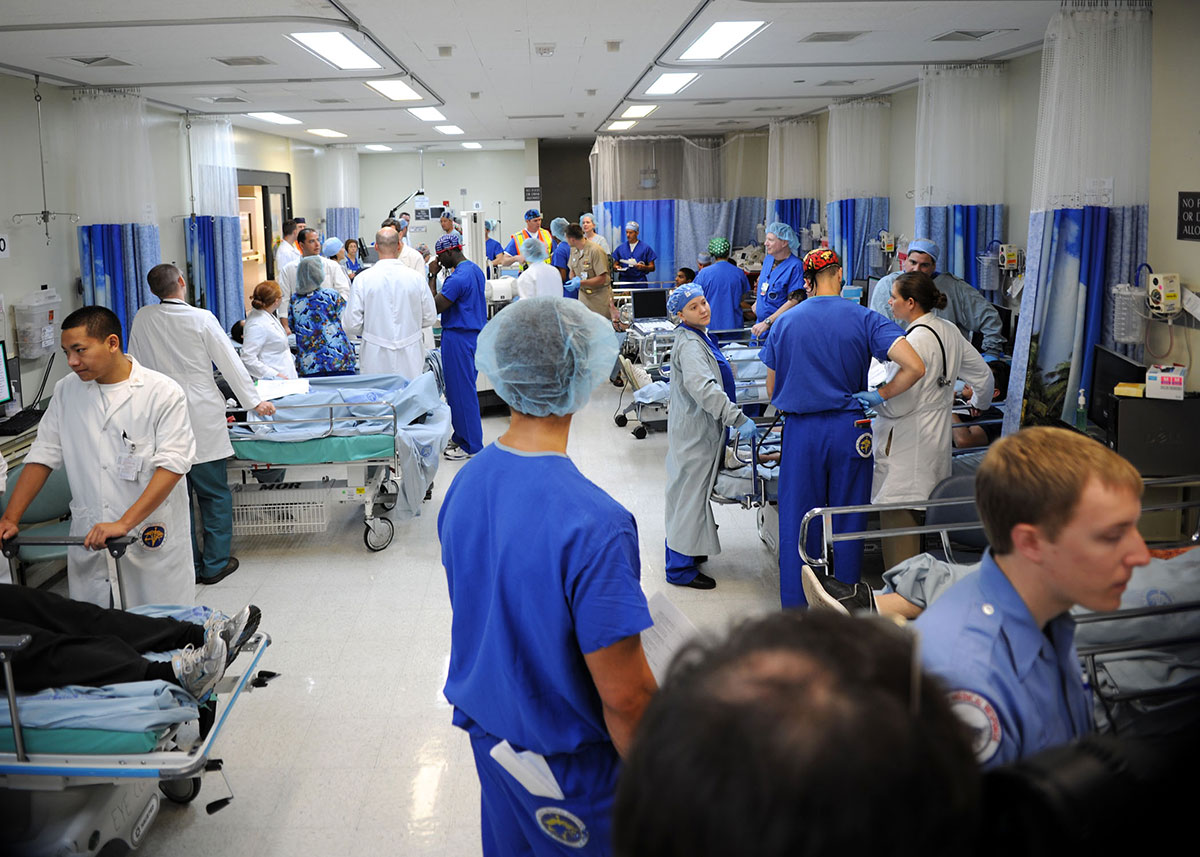
When someone arrives at an emergency department after a chemical exposure event, the clock starts immediately. What agent was involved? Is an antidote available? How much time is there? These are questions that emergency medicine practitioners have historically had to answer with incomplete information, under pressure, in real time. A recent episode of Technologically Speaking, the official podcast of the DHS Science and Technology Directorate, offers clinical and public health professionals a rare window into the federal laboratory working to change that — the Chemical Security Analysis Center, or CSAC, located at Edgewood, Aberdeen Proving Ground.
Deputy Director Helen Mearns, a chemical defense professional whose career spans the U.S. Army and DHS, spoke with host Brittany Greco about the medical dimensions of CSAC’s mission — dimensions that rarely receive attention outside the emergency management community but carry direct implications for hospital preparedness, mass casualty triage, and antidote deployment.
Biomarker Detection as a Clinical Triage Tool
One of the most clinically significant research directions Mearns described involves human biomarker detection for cyanide exposure. The human body has a natural pathway for mitigating cyanide, but that pathway can be overwhelmed at sufficient exposure levels — and in a mass casualty scenario involving a chemical release near industrial facilities or in a confined space fire, clinicians may receive multiple patients with overlapping and ambiguous presentations.
CSAC is investigating colorimetric detection of the cyanide biomarker as a rapid, point-of-care triage tool. The goal is to identify exposure quickly enough that a treating clinician can determine — before a patient’s condition deteriorates — whether antidote administration is warranted. An antidote for cyanide poisoning exists, but like many chemical countermeasures, its effectiveness is time-sensitive. Mearns framed the detection work explicitly in triage terms: the ability to rapidly confirm exposure means clinicians do not have to wait for symptomatic progression before acting.
Mearns noted that if the same biomarker detection chemistry can be translated to fabric applications, it would have implications for both first responders and military personnel — a wearable exposure indicator that signals the need for antidote administration in the field before a patient even reaches a hospital.
HExCAT: Putting Medical Mitigation Into the Blast Model
Mass casualty events involving explosives present a specific challenge for hospital incident command: the nature and distribution of injuries are difficult to predict in advance, and pre-positioning of medical resources depends on assumptions that may not match the actual event. CSAC’s Homeland Explosives Consequence Assessment Tool (HExCAT) was designed in part to address this gap.
What distinguishes HExCAT from conventional explosion modeling tools is the inclusion of a medical mitigation component alongside the blast physics and chemistry modeling. For emergency managers and hospital preparedness planners, this means a tool that can project not only the physical consequences of an explosive event but also the medical response requirements — what interventions are likely to be needed, and at what scale. Mearns emphasized that the goal is to enable on-scene medical response before ambulance arrival or hospital transfer — compressing the time between exposure and treatment in the critical early minutes of a mass casualty event.
Synthetic Opioids: A Mass Casualty Exposure Threat
The fentanyl and synthetic opioid crisis is primarily understood as a public health and law enforcement problem, but CSAC’s involvement reflects a distinct dimension: the mass casualty exposure scenario. Synthetic opioids are extraordinarily potent, active in microgram quantities, and increasingly diverse in chemical structure as illicit manufacturers modify compounds to evade detection. For hospitals and emergency medical systems, a large-scale exposure event (whether accidental or deliberate) involving aerosolized or otherwise dispersed synthetic opioids would present a surge of patients with respiratory depression requiring rapid naloxone administration at scale.
CSAC’s detection work on synthetic opioids focuses on developing algorithmic libraries broad enough to capture structural variants across the known fentanyl analog landscape, and sensitive enough to detect the trace quantities involved. The clinical implication is downstream but direct: better detection at ports of entry and in the field means fewer exposure events reaching emergency departments, and faster agent identification when they do.
Chemical Exposure From Fires: An Underrecognized Clinical Hazard
Mearns raised a chemical exposure pathway that emergency physicians encounter regularly but that public health messaging rarely addresses explicitly: toxic chemical release from structural fires. Modern building materials and furnishings are heavily synthetic, and combustion of these materials releases a complex mixture of toxic compounds — including hydrogen cyanide, carbon monoxide, and a range of irritant and asphyxiant gases — that can affect both building occupants and first responders.
CSAC’s interest in fire-related chemical exposure connects directly to its biomarker and detection research: understanding the toxic chemical profile of structural fire smoke informs both the clinical management of smoke inhalation patients and the protective equipment requirements for firefighters and emergency medical personnel operating at fire scenes. For emergency departments in urban areas, this research has practical implications for the triage and treatment of patients who arrive with undifferentiated smoke inhalation presentations that may involve cyanide toxicity alongside carbon monoxide poisoning.
The full episode is available on Apple Podcasts, YouTube, and at DHSSciTech on social media.
The Science and Human Impact of Chemical Threats – DHS Science & Technology Directorate, Technologically Speaking Podcast (Season 6, Episode 1)