

Every year, tens of billions of dollars in biopharmaceutical products are lost to cold chain failures: spoiled in transit, stranded on tarmacs, destroyed by power outages. For patients depending on CAR-T cell therapies, those losses can be fatal. For public health emergency responders, cold chain dependence has long represented a critical vulnerability. Vaccines, biologics, and medical countermeasures that cannot survive without refrigeration are far harder to deploy at speed and scale when it matters most. A federal health research agency is now making one of the most ambitious bets in biomedical history: that science can eliminate cold storage requirements for live cell therapies entirely, and in doing so, reshape how the United States produces and deploys its entire portfolio of temperature-sensitive medicines.
The Advanced Research Projects Agency for Health (ARPA-H) launched its BioStabilization Systems program (BoSS), earlier this year, with a solicitation that remains active on SAM.gov as of this week. A fourth amendment to the solicitation was published May 14, extending the solution pitch deadline for independent verification and validation (IV&V) partners to May 21, 2026, giving organizations with relevant capabilities a narrow remaining window to engage. The program seeks development of a platform biostabilization technology capable of preserving live cell-based therapies at ambient temperatures — a leap of more than 200 degrees Celsius above current cryogenic storage conditions.
The Problem: A Refrigeration Crisis Hiding in Plain Sight
More than 150 million Americans, over half the population, currently take a thermally sensitive medicine, whether a vaccine, blood product, immunotherapy, or biologic. The COVID-19 pandemic made this vulnerability impossible to ignore: mRNA vaccines required ultra-cold storage at -80°C, straining distribution infrastructure and limiting access in rural, resource-limited, and conflict-affected settings worldwide. Medical countermeasure planners have long recognized that any advanced biologic requiring cold chain, whether a next-generation vaccine, a cell-based therapeutic, or a biological agent antidote, carries an inherent logistics fragility that can undermine emergency response at precisely the moment resilience is most needed.
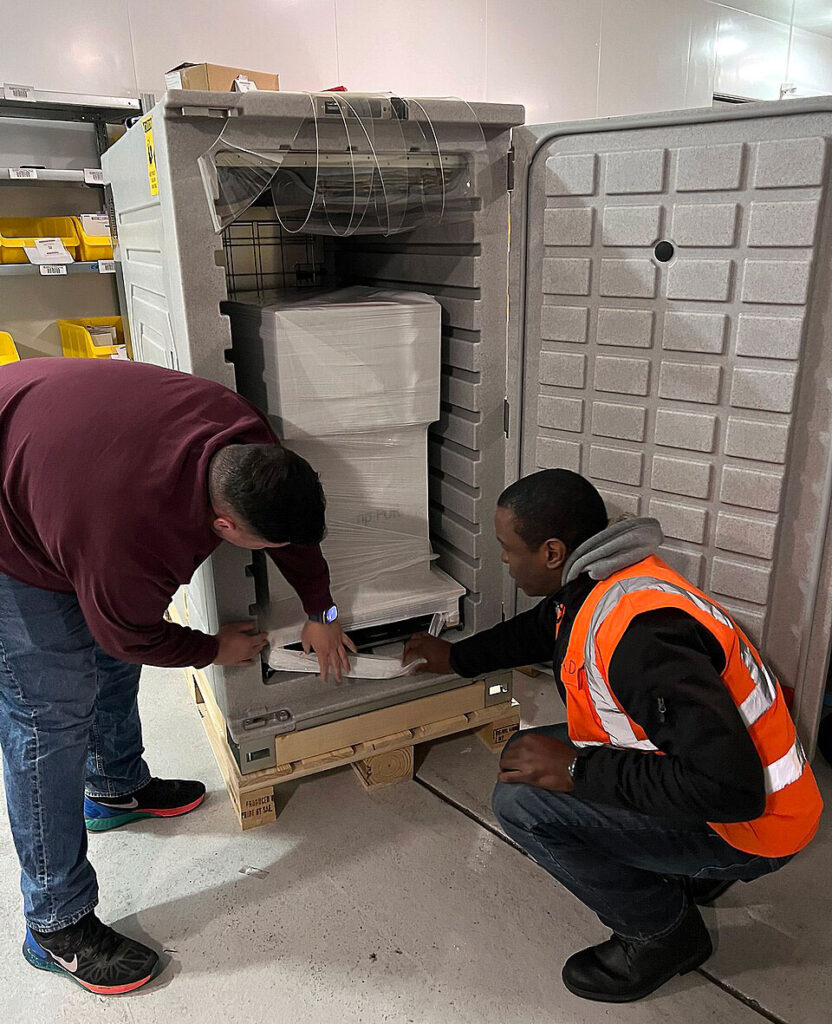
Cold chain logistics for thermally sensitive products cost an estimated $21 billion annually in the United States alone, a figure projected to reach $51 billion by 2035. Product losses tied to cold chain failures already run into the tens of billions per year and are expected to exceed $100 billion by 2035 as therapies grow increasingly complex and expensive.
The problem is most acute for cell and gene therapies, particularly CAR-T treatments: engineered immune cell products used to treat blood cancers and increasingly being studied for other cancers, autoimmune diseases, and conditions associated with aging. These therapies require liquid nitrogen storage at temperatures as low as -196°C throughout manufacturing, shipping, and clinical administration. Hospitals wishing to offer CAR-T must invest in specialized cryogenic infrastructure simply to participate. Cold chain handling adds $20,000 to $50,000 to the cost of a single therapy. A shipment delayed by a snowstorm or mechanical failure can result in total product loss, and for many patients, the loss of their only remaining treatment option.
Despite growing demand, CAR-T therapies are currently delivered to thousands to tens of thousands of patients annually. The potential patient population numbers in the millions.
What BoSS Is Asking For
The BoSS program’s technical objective is to develop a scalable bioprocessing system capable of producing thermally stable cells that can be stored and distributed at room temperature for extended periods, then successfully reanimated for clinical use. The solicitation describes this as a platform approach, meaning the technology should work across multiple cell types, integrate into existing biomanufacturing pipelines, and have a clear path to FDA compliance and commercial viability.
ARPA-H has structured the program around two core technical areas. The first, TA1, focuses on cell biology and materials chemistry, identifying the biological and chemical protectants needed to put cells into a stable, suspended state without killing them. Nature already does this: tardigrades, brine shrimp, and certain plants can survive complete desiccation and then reanimate. The program draws on recent advances in understanding how these extremophiles use molecules like trehalose, intrinsically disordered proteins, and structural cellular reorganization to survive without water.
The second area, TA2, focuses on bioprocessing: the engineering systems and instruments needed to deliver stabilization at scale. ARPA-H is explicitly not prescribing any single approach, welcoming proposals drawing on spray drying, next-generation lyophilization, encapsulation, or entirely novel methods, provided they can be scaled, validated, and eventually commercialized.
An IV&V partner will be separately contracted to confirm that stabilization methods developed by technical performers are reproducible across laboratories, a critical quality control measure given how frequently promising techniques fail to transfer outside the originating lab.
Broader Implications for Medical Countermeasures
A successful BoSS program would carry consequences well beyond oncology. Ambient-stable biologics would fundamentally change the logistics calculus for medical countermeasure stockpiling and deployment, enabling faster and more flexible responses to pandemics, bioterrorism events, and mass casualty incidents without dependence on cold storage infrastructure that may be unavailable or destroyed in a crisis. The same platform advances could strengthen biosurveillance capabilities, expand regenerative medicine, improve blood product supply chains, and support wound repair in forward military environments.
For everyday patients, the implications are equally significant. Ambient preservation would reduce the energy footprint of biopharmaceutical distribution, expand access to rural and underserved communities, and lower the cost of therapies that currently carry enormous logistical overhead. ARPA-H officials framed the long-term vision explicitly: instead of blanketing the country with energy-intensive cryogenic warehouses, future cell therapies could be shipped to patients wherever they are, at home, in remote clinics, or in operational military settings.
Sources and further reading:
BioStabilization Systems (BoSS) – SAM.gov