

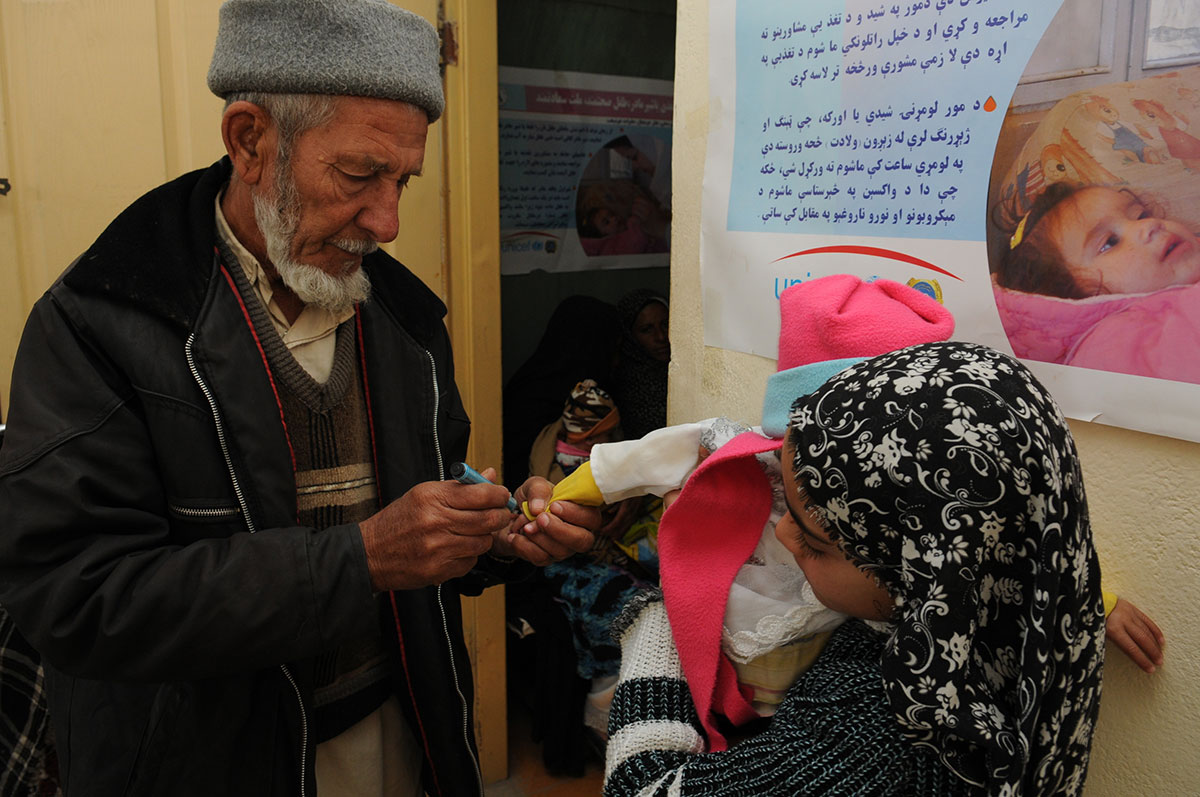
A two-year-old girl in Uruzgan province has been paralyzed by wild poliovirus, bringing Afghanistan’s confirmed 2026 cases to 16. WHO confirmed the case on August 13; the child’s family had refused vaccination. Afghanistan and Pakistan remain the only countries where wild poliovirus is endemic, forming a single transmission corridor driven by cross-border population movement.
Afghanistan is entering high-transmission season, when poliovirus spreads most efficiently through under-immunized communities. Most cases have occurred in eastern and southern provinces bordering Pakistan. One case detected in western Herat province signals geographic expansion beyond the southern core. Pakistan has reported three cases in 2026, bringing the two-country total to 18 this year compared with 52 in 2025 and 99 in 2024. Though 2026 lags 2024’s pace, rising case counts coincide with high-transmission season onset, raising epidemiologist concerns.
A combined 161 WPV1-positive environmental samples were detected in 2026—53 in Afghanistan, 108 in Pakistan—across provinces including Uruzgan, Kandahar, Helmand, Herat, Kunduz, and Badghis, indicating distributed viral circulation. Because each paralytic case represents an estimated 200+ asymptomatic infections, the 16 cases suggest substantially broader undetected spread in under-immunized communities.
Taliban authorities restrict house-to-house vaccination campaigns and limit health worker access to insecure districts. Vaccine hesitancy, fueled by misinformation linking vaccines to infertility or foreign espionage, further reduces uptake. The Uruzgan case illustrates how these barriers compound: the girl’s family refused vaccination, symptoms developed months before confirmation, delaying response. Limited diagnostic capacity and delays between symptom onset and laboratory confirmation further hamper contact tracing and containment.
Polio eradication is one of global health’s most consequential unfinished projects. Since 1988, cases have declined 99%. Afghanistan and Pakistan are the last barriers to complete eradication—a permanent milestone achievable only through full transmission interruption in both countries.
Sources and further reading:
Wild poliovirus type 1 (WPV1) case reported in Afghanistan, bringing total cases to 16 in 2026 – BEACON
New Polio Case Reported in Afghanistan as Cases Continue to Rise – Kabul Now
New Polio Case Reported in Afghanistan’s Uruzgan Province – Khaama Press
This article was researched and sourced by Global Biodefense editors and reported with Claude AI assistance for drafting and editing.