

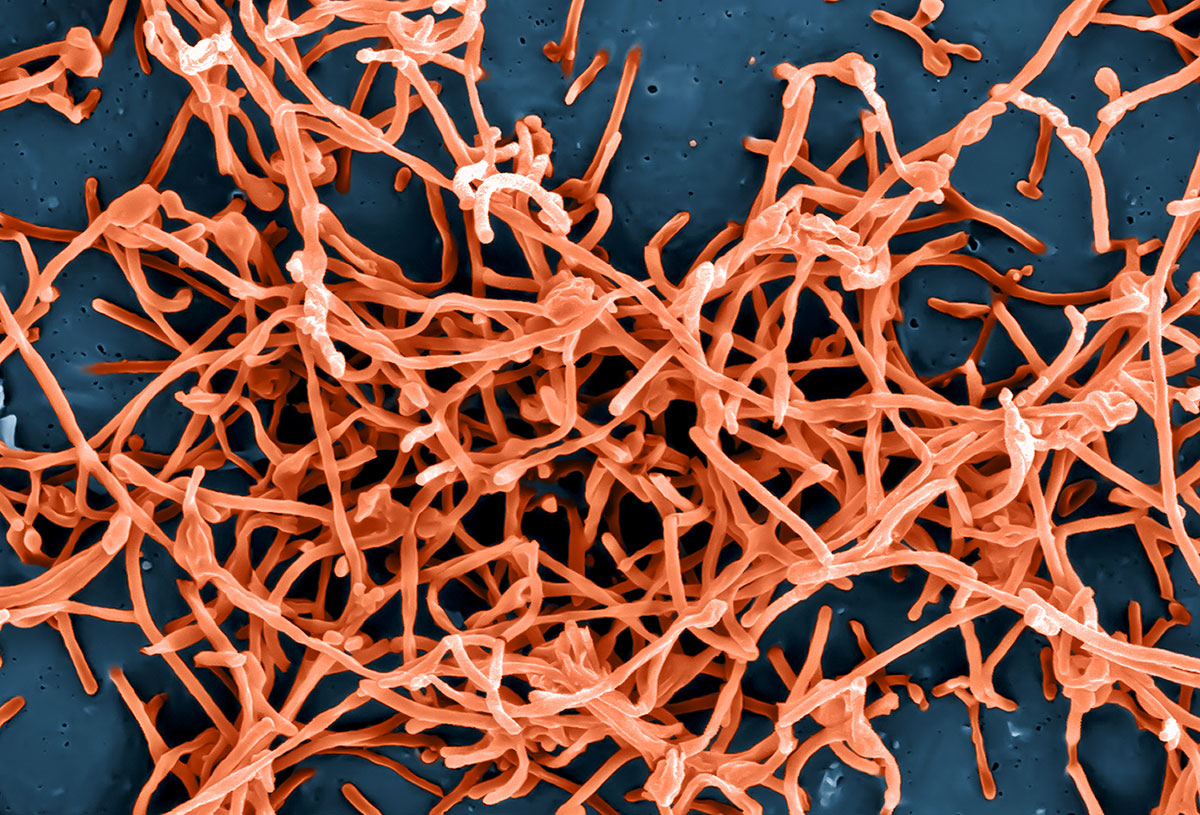
New laboratory research has identified a human protein that Ebola virus appears to hijack in order to first suppress, then later disrupt, the body’s immune response, offering new insight into why Ebola virus disease produces such dangerous and unpredictable inflammation.
Researchers from Rutgers University, the University of Texas Medical Branch at Galveston, and Cincinnati Children’s Hospital, publishing in the journal Viruses, examined how a human enzyme called PTPN13 influences the immune system’s response to Ebola virus infection. Ebola virus disease is a severe and often fatal illness marked by excessive inflammation, a phenomenon in which the immune system’s own response to infection ends up causing extensive damage to the body. While scientists have long observed that patients with the worst outcomes tend to have the highest levels of inflammatory molecules in their blood, the underlying mechanisms driving this harmful overreaction have remained poorly understood.
PTPN13 belongs to a family of enzymes called phosphatases, which work by removing chemical tags called phosphate groups from other proteins, essentially acting as an off switch for various cellular processes. The research team found that PTPN13 targets a protein called IRF3, which normally triggers the production of interferon, a signaling molecule central to the body’s earliest antiviral defenses. By removing a specific phosphate tag from IRF3, PTPN13 dials down interferon production. The same enzyme also appears to promote production of a separate molecule called CXCL1, which attracts a type of white blood cell called neutrophils to the site of infection.
To reach these findings, the researchers infected several types of human and mouse immune cells with live Ebola virus under high-containment biosafety conditions, alongside parallel experiments using a laboratory tool that mimics viral infection without live virus, then measured how removing or overexpressing PTPN13 changed the cells’ immune signaling. They also used genetically modified virus and cell lines lacking the enzyme entirely to isolate its specific effects, and applied gene sequencing to track how thousands of genes responded to infection over time.
The most striking result was a shift over the course of infection. Early after infection, cells lacking PTPN13 mounted a stronger interferon response than normal cells, suggesting the enzyme initially works in the virus’s favor by holding back the body’s defenses. But by 48 hours after infection, the pattern reversed. Cells lacking PTPN13 produced less interferon and fewer of the antiviral genes interferon normally switches on, and these cells ended up with higher levels of virus than cells that still had the enzyme. The researchers also found that PTPN13 directly interacts with VP35, a well known Ebola virus protein that normally acts as a potent suppressor of interferon signaling, and that PTPN13 can reduce VP35’s activity by removing its phosphate tags, which in turn slowed viral replication in laboratory assays.
The findings suggest PTPN13 does not play a simple, one directional role during infection. Rather, it appears to help the body strike a balance, dialing back a potentially damaging immune overreaction early in infection while also directly interfering with a key viral protein that the virus depends on to replicate. When that balance is disrupted, either by knocking out the enzyme in these laboratory experiments or, potentially, through the virus’s own manipulation of PTPN13 levels during a real infection, the result is a immune response that becomes dysregulated rather than protective.
For biosecurity and public health researchers, the discovery adds to a growing body of work identifying specific molecular pathways that Ebola virus manipulates to survive inside its host, pathways that could eventually become targets for new antiviral therapies or tools to predict which patients face the highest risk of severe disease. Because heightened inflammation has repeatedly been linked to fatal outcomes in prior Ebola outbreaks, a clearer picture of what drives that inflammation could eventually inform how clinicians manage critically ill patients during future outbreaks.
The experiments were conducted in cell culture and isolated immune cells rather than in a living animal, so it remains unclear how PTPN13’s effects on inflammation translate to disease severity in an infected organism. The researchers note that further studies using animal models will be needed to confirm how these effects on inflammation and viral replication play out during an actual infection, and to determine whether the enzyme could ultimately serve as a therapeutic target.
Sources and further reading:
Warren AN, Gonzalez-Orozco M, Kuzmin I, et al. PTPN13 Contributes to Ebola Virus-Induced Immune Dysregulation via Dephosphorylation of IRF3 and PI3K-p85. Viruses, June 30, 2026.
This article was researched and sourced by Global Biodefense editors and reported with Claude AI assistance for drafting and editing.